Whitney Houston remains one of the most influential voices in music history, but her financial story is just as fascinating as her record-breaking career. From her breakthrough in the 1980s to blockbuster soundtracks, global tours, film appearances, and continuing catalog sales, Houston built multiple sources of income during her lifetime. Her official biography says she sold more than 220 million albums, singles, and videos worldwide, while The Bodyguard soundtrack became one of the biggest-selling soundtracks ever.
Determining Whitney Houston’s exact net worth is more complicated because she died in 2012 and her estate continues to generate revenue. Public estimates can differ depending on debts, contracts, royalties, catalog interests, licensing arrangements, and posthumous earnings. Guinness World Records reported that Houston’s estate generated an estimated $30 million during the 12 months ending October 2023. This article separates documented career achievements from third-party financial estimates to provide a clearer picture of Whitney Houston’s wealth, income sources, and enduring financial legacy.
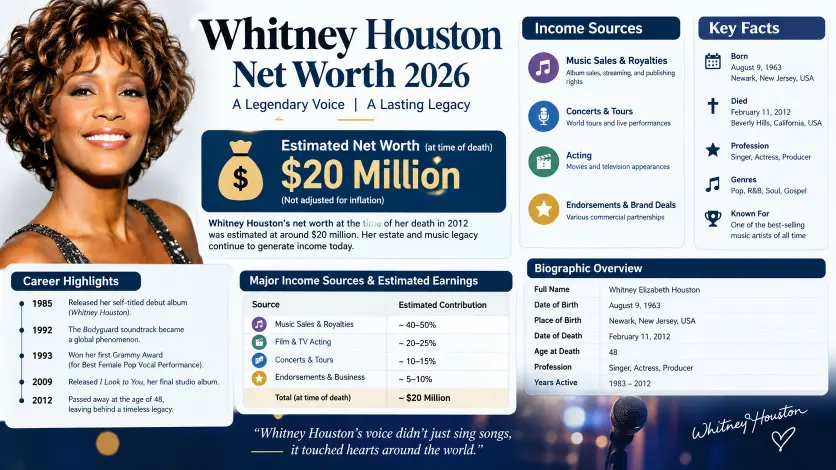
Whitney Houston Net Worth 2026: At a Glance
| Category | Details |
| Full name | Whitney Elizabeth Houston |
| Born | August 9, 1963 |
| Died | February 11, 2012 |
| Profession | Singer and actress |
| Country | United States |
| Music career | 1980s–2012 |
| Grammy wins | 6 |
| Grammy nominations | 25 |
| Records sold | More than 220 million, according to the Recording Academy |
| Reported estate value | Estimates vary significantly |
| Verified 2026 net worth | Not publicly verified |
| Major income sources | Music, recordings, film, soundtrack-related income, licensing and estate activity |
The financial figures above should not be treated as audited personal wealth. In particular, reported estate values from different periods may describe different things—assets, debts, posthumous income, or the value of particular rights.
Why Whitney Houston’s Net Worth Is Difficult to Calculate
Celebrity net-worth figures are often presented as a single number, but Houston’s finances demonstrate why that approach can be misleading.
At the time of her death, media reports described a financially complicated estate. Forbes reported in 2012 that Houston had signed a $100 million deal with Arista Records in 2001, but the economics of that agreement did not mean she simply received $100 million in disposable personal wealth. Advances, recording costs, sales performance and contractual obligations all affect what an artist ultimately retains.
Forbes also explained that Houston’s posthumous recording income could be substantial, while pointing out an important distinction between Houston and artists who owned extensive songwriting or publishing interests. Many of Houston’s best-known songs were written by other songwriters.
This is why Whitney Houston net worth should be treated as an estimate rather than a confirmed 2026 balance sheet.
Whitney Houston’s Music Career and Wealth Creation
Houston’s financial story begins with her extraordinary recording career.
Her self-titled debut album was released in 1985 and produced major hits including “Saving All My Love for You,” “How Will I Know,” and “Greatest Love of All.” The album reached No. 1 on the Billboard 200 and established Houston as an international star.
Her commercial momentum continued with albums such as Whitney, I’m Your Baby Tonight, My Love Is Your Love and I Look to You. The Recording Academy notes that Houston accumulated more than 20 Billboard Hot 100 Top 10 hits and four No. 1 albums during her career.
Her music therefore represented a major source of career income through:
- Album sales
- Single sales
- Streaming
- Performance-related income
- Licensing
- Soundtrack participation
- Music-related commercial agreements
But gross revenue is not the same thing as personal profit. Record labels, managers, agents, production expenses, taxes and other contractual costs can reduce the amount an artist actually retains.
The Bodyguard and Whitney Houston’s Film Income
Houston’s wealth was not generated by music alone.
Her acting debut came in the 1992 film The Bodyguard, in which she starred alongside Kevin Costner. The movie’s soundtrack became a major commercial success and included her signature recording of “I Will Always Love You.”
The Recording Academy recognizes The Bodyguard soundtrack as a major part of Houston’s legacy and notes that the album earned Album of the Year recognition at the Grammys.
Houston later appeared in Waiting to Exhale and The Preacher’s Wife, expanding her entertainment career beyond conventional album releases.
She also appeared posthumously in Sparkle, released in 2012. Forbes reported at the time that the film’s economics did not provide a major back-end financial opportunity for Houston’s estate.
Whitney Houston’s Posthumous Income
One of the most important parts of understanding Houston’s financial legacy is what happened after her death.
Her music continued selling and generating licensing and royalty-related income. Forbes reported that her catalog experienced a major sales increase following her death in 2012.
More recently, Forbes reported that Houston generated $13 million in pretax earnings during the October 1, 2023–September 30, 2024 period used for its 2024 highest-paid dead celebrities list. Forbes said the calculation included sales, streams, licensing and other income and noted that Houston-branded slot machines were another source of estate revenue.
That $13 million figure is not Whitney Houston’s net worth. It represents estimated earnings during a specific measurement period.
This distinction is crucial when discussing the keyword Whitney Houston net worth 2026.
How the Whitney Houston Estate Can Still Make Money
Houston’s estate continues to benefit from the commercial value of her name, recordings and legacy.
Potential and documented revenue channels include:
1. Music Sales and Streaming
Houston’s classic songs continue to be consumed through digital platforms, physical releases and other forms of recorded-music distribution.
Her catalog remains commercially significant decades after her breakthrough.
2. Licensing
Houston’s name, likeness, recordings and intellectual property can be licensed for commercial projects.
Forbes specifically reported licensing activity as part of the income considered in its 2024 dead-celebrity calculations.
3. Brand and Entertainment Partnerships
The estate can participate in carefully managed commercial projects involving Houston’s image, music and legacy.
This is different from Houston personally earning money during her lifetime; the relevant economic entity today is her estate and its business partners.
4. Music-Related Experiences
Houston’s music has also been incorporated into entertainment products.
Forbes reported that Whitney-branded slot machines were generating royalty-related income and that at least 1,000 machines were planned through 2025.
5. New Legacy Projects
The estate has continued developing projects around Houston’s music.
The official Whitney Houston website reported that the estate and Primary Wave Music planned events around the 40th anniversary of Houston’s career, including The Voice of Whitney: A Symphonic Celebration.
The official site also lists further Voice of Whitney performances extending into the 2026–2027 period.
Whitney Houston’s Estate in 2026
There is no independently verified public figure establishing Whitney Houston’s exact estate value in 2026.
Some websites currently publish figures around $20 million, while other online sources report substantially different amounts. Those figures should not automatically be treated as authoritative because estate value depends on assets, liabilities, contractual rights, taxes, ownership interests and the valuation date.
A particularly important historical source is Forbes’ reporting that media outlets had described Houston’s estate as having a value around $20 million after her death, while also explaining that the accuracy of such figures could not be confirmed.
Consequently, the safest factual conclusion is:
Whitney Houston’s exact 2026 net worth is not publicly verified.
The estate clearly continues to generate commercial income, but annual earnings are not equivalent to total estate value.
Whitney Houston’s Career Achievements
Financial discussions can overlook why Houston’s intellectual property remains commercially valuable.
Her career included:
- Six Grammy Awards
- 25 Grammy nominations
- Multiple No. 1 albums
- More than 20 Billboard Hot 100 Top 10 hits
- Seven consecutive No. 1 Billboard Hot 100 singles
- Major film and soundtrack success
- More than 220 million records sold worldwide according to the Recording Academy
In 2026, the Recording Academy also recognized Houston with a 2026 Special Merit Award, further demonstrating the continuing institutional recognition of her contribution to recorded music.
What Happened to Whitney Houston’s Wealth?
Houston’s financial circumstances changed substantially over the course of her career.
She achieved extraordinary commercial success, but financial success does not necessarily mean that an artist possesses an equally large amount of liquid wealth.
Her estate faced financial complications around the time of her death, while later music sales and commercial activity increased the economic value associated with her legacy. Forbes reported that increased sales after her death helped generate millions of dollars for the estate.
This illustrates an important point for readers researching celebrity net worth: career earnings, personal wealth, estate value and posthumous earnings are four different measurements.
Whitney Houston Net Worth vs. Posthumous Earnings
These terms are often confused.
Net worth means the value of assets minus liabilities at a particular point in time.
Estate value refers to the assets and financial interests controlled by an estate, subject to liabilities and other obligations.
Posthumous earnings are revenues or earnings generated after someone’s death.
For example, Forbes estimated Houston’s posthumous earnings at $13 million for its 2024 measurement period, but that does not mean her estate was worth $13 million or that her total net worth was $13 million.
Similarly, estimates of $20 million or other historical figures should not automatically be presented as a definitive 2026 net-worth figure.
Whitney Houston Net Worth 2026: Future Outlook
Because Houston is deceased, the relevant financial outlook concerns the estate’s future earning potential, not personal future income.
Houston’s recordings remain culturally relevant, while licensing, streaming, entertainment projects and carefully managed uses of her name and likeness can continue generating revenue.
The official Whitney Houston estate has continued to organize musical and legacy projects, including The Voice of Whitney performances extending into 2026 and 2027.
However, projecting a precise future estate value would require information that is not publicly available, including current contracts, expenses, ownership percentages, taxes and private financial statements.
Therefore, a specific future net-worth number would be speculative rather than fact-checked financial reporting.
Whitney Houston Net Worth: Income Sources
Whitney Houston’s financial legacy is unusual because her career earnings did not end with her death in 2012. Her recordings, performances, film work, name and likeness, licensing agreements, and other intellectual-property interests have continued to generate revenue for her estate. That makes Whitney Houston’s wealth different from the finances of a living singer: today, much of the money associated with her name is earned through the continued commercial use of work she created during her lifetime.
The exact amount of Whitney Houston’s net worth is difficult to establish because there is no single publicly audited figure that captures the value of every asset, royalty stream, contractual interest, debt, and estate arrangement. Third-party estimates can therefore vary substantially.
One useful benchmark is Forbes’ 2023 estimate. Forbes calculated that Houston’s estate earned approximately $30 million between October 1, 2022, and September 30, 2023. Guinness World Records also records the same $30 million figure for the 12 months to October 1, 2023.
That figure should not automatically be treated as Whitney Houston’s net worth. It represents estimated estate earnings during a particular period, before certain expenses. Understanding the different income sources helps explain why her financial legacy remains commercially significant.
1. Music Sales and Album Revenue
Music recordings were one of Whitney Houston’s most important career assets.
Houston released some of the most commercially successful albums of her generation. Her official biography states that she sold more than 220 million albums, singles, and videos worldwide during her career.
Her recordings can continue producing money through:
- Physical album sales
- Digital downloads
- Streaming
- Compilation albums
- Reissues
- Special editions
- International distribution
- Licensing of recorded music
Whitney Houston’s Major Albums
Her self-titled 1985 debut album established her as a major recording artist. Her second album, Whitney, became the first album by a female artist to debut at No. 1 on the U.S. Billboard album chart, according to her official biography.
Other commercially important releases included:
- Whitney Houston
- Whitney
- I’m Your Baby Tonight
- The Bodyguard soundtrack
- Waiting to Exhale soundtrack
- The Preacher’s Wife soundtrack
- My Love Is Your Love
- Just Whitney
- I Look to You
Every time listeners purchase, stream, license, or otherwise commercially use eligible recordings, rights holders may receive revenue according to the relevant contracts and ownership arrangements.
2. Streaming Revenue
Streaming has become an important part of the modern music business.
Unlike the physical music market of the 1980s and 1990s, today’s listeners can access Whitney Houston’s catalog through digital music platforms. Her most recognizable songs continue to attract listeners decades after their original releases.
Streaming can generate revenue from:
- Audio platforms
- Video platforms
- Digital music services
- Licensed playlists
- Compilation services
- International streaming markets
The exact amount generated by Houston’s catalog from streaming is not publicly disclosed in a comprehensive audited annual statement.
That distinction matters when discussing her net worth. A song having billions of streams does not mean the artist or estate receives the same amount as the platform’s gross revenue. Money can be divided among rights holders, labels, publishers, distributors, songwriters, and other parties depending on the underlying rights.
3. Songwriting and Publishing Rights
Music publishing is another potential source of long-term income connected to Houston’s catalog.
A song can generate publishing revenue when it is:
- Reproduced
- Performed publicly
- Broadcast
- Streamed
- Licensed for audiovisual productions
- Used commercially
- Covered or adapted under applicable rights
However, Houston did not write every major song associated with her career.
For example, “I Will Always Love You” was written by Dolly Parton. Houston’s recording became enormously successful, but the songwriting copyright and the recording copyright are separate assets.
This is an important point when estimating celebrity wealth: owning or performing a recording does not necessarily mean owning the underlying composition.
4. The Bodyguard Soundtrack
One of Whitney Houston’s largest commercial achievements was The Bodyguard soundtrack.
Her official biography states that the soundtrack has sold more than 45 million copies worldwide and reached 19-times platinum certification in the United States.
The project was particularly important because it connected Houston’s music career with her acting career.
The soundtrack included:
- “I Will Always Love You”
- “I’m Every Woman”
- “I Have Nothing”
- “Run to You”
The continuing popularity of these recordings means the soundtrack can remain commercially relevant long after its original release.
Why The Bodyguard Still Matters Financially
A highly successful catalog can create a recurring stream of revenue through:
- Streaming
- Radio
- Film and television licensing
- Commercial licensing
- Digital sales
- Physical reissues
- Compilation releases
The exact percentage received by Houston’s estate depends on ownership and contractual arrangements that are not fully public.
5. “I Will Always Love You” Revenue
“I Will Always Love You” remains one of the most recognizable recordings associated with Whitney Houston.
The song was originally written by Dolly Parton, but Houston’s version became a massive worldwide hit.
Her official website describes the recording as the biggest-selling single by a female artist and notes its 11-times-platinum U.S. certification.
Its financial value comes from the continuing commercial use of the recording.
Potential revenue channels include:
- Streaming
- Digital purchases
- Radio
- Compilation albums
- Film and television use
- Commercial licensing
- Physical releases
Again, gross commercial activity should not be confused with the amount ultimately received by Houston’s estate.
6. Film and Acting Income
Whitney Houston was not only a singer. She also developed a successful film career.
Her most famous movie role came in The Bodyguard, where she starred alongside Kevin Costner.
She later appeared in:
- Waiting to Exhale
- The Preacher’s Wife
- Cinderella
- Sparkle
Film work could produce income through:
- Acting fees
- Performance-related contracts
- Soundtrack participation
- Residual arrangements
- Licensing
- Home entertainment
- Television distribution
The financial structure of each production can differ, so it is not accurate to assume a single fixed percentage of movie revenue went directly to Houston.
7. The Bodyguard Movie and Soundtrack Combination
The financial importance of The Bodyguard came from the combination of film and music.
The movie gave Houston a major acting platform while its soundtrack became a global music phenomenon.
This created multiple commercial channels around the same project.
The film could generate money through:
- Theatrical distribution
- Home entertainment
- Television licensing
- Streaming
- International distribution
Meanwhile, the soundtrack could generate income through:
- Album sales
- Streaming
- Radio
- Licensing
- Reissues
This combination helped make The Bodyguard one of the defining commercial projects of Houston’s career.
8. Waiting to Exhale
Waiting to Exhale was another important film and soundtrack project.
Houston starred in the movie alongside Angela Bassett, Loretta Devine, and Lela Rochon. The soundtrack also included several Whitney Houston recordings.
Her official biography reports that the soundtrack spent five weeks at No. 1 and became seven-times platinum in the United States.
This demonstrates an important part of Houston’s business model: her film career and recording career frequently worked together rather than existing as completely separate income streams.
9. The Preacher’s Wife
Another major project was The Preacher’s Wife.
Houston starred with Denzel Washington and Courtney B. Vance, while the soundtrack became particularly important to her music catalog.
According to her official biography, the soundtrack became the biggest-selling gospel album in Billboard chart history and reached three-times platinum in the United States.
The project therefore contributed to Houston’s commercial footprint in both film and music.
10. Touring and Concert Revenue
During her lifetime, touring was another major source of potential income.
Concert revenue can come from:
- Ticket sales
- Promoter agreements
- Performance fees
- Merchandise
- Sponsorships
- VIP packages
- International performances
Houston performed worldwide throughout her career.
Her official biography notes that she began the 60-date My Love Is Your Love Tour in 1999, demonstrating the scale of her international touring activity.
However, tour gross revenue is not the same as personal profit.
A major tour can involve substantial expenses, including:
- Production
- Musicians
- Dancers
- Crew
- Transportation
- Hotels
- Venues
- Insurance
- Management
- Promotion
Therefore, historical tour grosses should not automatically be added to Whitney Houston’s net worth.
11. Merchandise and Brand Licensing
Whitney Houston’s name, image, music, and recognizable identity have commercial value beyond recordings.
Her estate can potentially generate income through authorized:
- Clothing
- Beauty products
- Collectibles
- Memorabilia
- Promotional campaigns
- Branded merchandise
- Special collaborations
Forbes reported that the Houston estate’s 2023 earnings were helped by brand collaborations, including a MAC Cosmetics collection.
This shows how celebrity estates can monetize an artist’s identity decades after their death.
12. MAC Cosmetics Collaboration
One notable posthumous commercial partnership was the collaboration between MAC Cosmetics and the Whitney Houston estate.
Forbes specifically identified the MAC collection as one of the factors contributing to the estate’s 2023 earnings.
Such agreements can provide income through licensing and commercial partnerships.
The important financial principle is that a brand collaboration does not necessarily mean the estate owns the brand or product company. Instead, the estate may receive an agreed fee, royalty, or other contractual compensation.
13. Biopic Revenue and Whitney Houston’s Story
The release of Whitney Houston: I Wanna Dance With Somebody created another important commercial opportunity for the Houston estate.
The film was released in 2022 and grossed approximately $60 million worldwide, according to Forbes and Guinness World Records.
A biographical movie can create income opportunities for an estate through arrangements involving:
- Name and likeness
- Life-story rights
- Music licensing
- Archival material
- Promotional partnerships
- Estate participation
The movie’s worldwide box office gross should not be interpreted as money received by Houston’s estate. Box-office revenue is distributed across the various participants in a film’s business structure.
14. Name and Likeness Rights
A celebrity’s name and likeness can become a valuable intellectual-property asset after death.
For Whitney Houston, the commercial use of her:
- Name
- Photograph
- Voice recordings
- Image
- Biography
- Music
- Signature identity
can be subject to estate and contractual rights.
These rights can potentially be licensed for entertainment, advertising, merchandise, and other approved commercial activities.
This is one reason celebrity estates can continue producing income for decades.
15. Posthumous Music Releases
An artist’s unreleased recordings can become commercially valuable after death.
Posthumous releases may involve:
- Previously unreleased songs
- Alternate versions
- Remastered albums
- Deluxe editions
- Live recordings
- Compilation albums
- Archival material
Every new release can potentially introduce older music to a new audience.
However, the financial outcome depends on ownership rights, contracts, production costs, distribution arrangements, and consumer demand.
16. Catalog Reissues and Remastered Music
Older albums can receive renewed commercial attention through anniversary editions and remasters.
This can generate additional revenue from:
- CD releases
- Vinyl
- Digital downloads
- Streaming
- Box sets
- Deluxe editions
Whitney Houston’s continued cultural relevance makes her catalog suitable for this type of long-term exploitation.
The official Whitney Houston site also reports that new RIAA certifications were announced in June 2025, including certifications for The Bodyguard soundtrack and several major songs. It stated that her U.S. RIAA-certified units totaled 115.5 million across 38 titles at that time.
17. Licensing Music for Movies and Television
Whitney Houston’s songs can also generate revenue when licensed for audiovisual productions.
A producer may need permission to use a recording in:
- Movies
- Television shows
- Documentaries
- Advertisements
- Trailers
- Online productions
- Special programming
There can be separate rights for the musical composition and the sound recording.
This makes music licensing another potentially valuable long-term income stream.
18. Commercial and Advertising Licensing
Recognizable music can have commercial value in advertising.
A brand that wants to use a famous recording may need to negotiate rights with the relevant owners.
For Houston’s catalog, potential commercial applications could include:
- Television advertisements
- Digital campaigns
- Brand videos
- Promotional content
- Entertainment marketing
The amount paid depends on factors such as the song, duration, territory, audience, campaign size, and contractual terms.
19. Estate Partnerships
The Whitney Houston estate has also used partnerships to develop her commercial legacy.
One frequently discussed partnership involves Primary Wave Music.
Celebrity Net Worth reports that Primary Wave acquired a 50% stake in Houston’s estate-related interests in 2019 for an estimated $14–20 million, although that figure is a third-party report rather than a publicly audited valuation.
Because estate transactions can involve complicated intellectual-property structures, the headline transaction value should not automatically be treated as Whitney Houston’s personal net worth.
20. Primary Wave and Legacy Development
Partnerships with entertainment companies can help estates develop catalogs and brands.
Potential activities include:
- Music promotion
- Licensing
- New merchandise
- Film projects
- Brand partnerships
- Catalog marketing
- Archival releases
For an artist with a globally recognized catalog, these activities can extend the commercial life of older recordings.
21. Digital Music and Social Media Exposure
Modern digital platforms have changed how older music is rediscovered.
A song released decades ago can become popular again because of:
- Viral videos
- Social media trends
- Movie appearances
- Television performances
- Fan-created content
- Anniversary events
- New generations discovering the artist
This can increase streaming activity and potentially create additional royalty income.
The exact annual streaming income associated with Houston is not publicly verified.
22. Tribute Performances and Legacy Projects
Whitney Houston’s music continues to be performed and celebrated through tribute projects and orchestral performances.
The official Whitney Houston website currently lists continuing The Voice of Whitney performances, including future dates extending into 2026 and 2027.
Such projects can help maintain public interest in her music and legacy.
However, not every tribute performance necessarily means the Houston estate receives direct revenue. Financial participation depends on the specific licensing and production agreement.
23. Television and Documentary Licensing
Houston’s life and career can also generate value through documentaries and television programming.
Projects about her career may use:
- Music recordings
- Interviews
- Photographs
- Video footage
- Archival material
- Name and likeness
Where estate-controlled rights are involved, licensing agreements can potentially produce revenue.
24. Physical Music Collectibles
Although streaming dominates today’s music market, physical products can still contribute to an artist’s legacy business.
Potential products include:
- Vinyl records
- Limited-edition albums
- Collector box sets
- Posters
- Signed memorabilia
- Anniversary releases
The collector market can be particularly relevant for artists with a historically important catalog.
25. International Music Revenue
Whitney Houston was a global artist rather than a U.S.-only performer.
Her official biography documents album certifications and commercial success across numerous international markets, including the United Kingdom, Canada, France, Germany, Japan, Australia, South Africa, and other countries.
International markets can generate income through:
- Streaming
- Radio
- Physical sales
- Digital downloads
- Licensing
- Television
- Film
- Merchandise
This worldwide reach is an important reason her catalog can remain commercially valuable.
Whitney Houston Income Sources at a Glance
| Income Source | Financial Role |
| Music sales | Major historical revenue source |
| Streaming | Continuing catalog revenue |
| Music royalties | Long-term potential income |
| Publishing rights | Revenue from compositions where applicable |
| Film | Acting and related contractual income |
| Soundtracks | Music and licensing revenue |
| Touring | Major lifetime performance-income source |
| Merchandise | Estate-related commercial opportunity |
| Brand collaborations | Licensing and partnership income |
| Biopic | Estate/rights-related commercial opportunity |
| Name & likeness | Licensing potential |
| Catalog reissues | Continuing music revenue |
| Television licensing | Potential royalty/licensing income |
| Advertising | Commercial music licensing |
| International rights | Global catalog revenue |
| Archival releases | Posthumous catalog income |
How Whitney Houston’s Estate Makes Money Today
Whitney Houston died in 2012, but the commercial life of her music did not end.
That is an important distinction when researching her net worth.
A living singer may earn money from concerts, interviews, new recordings, endorsements, and personal businesses. A deceased artist’s estate instead focuses heavily on intellectual property.
For Houston, this can include her recorded music, authorized uses of her identity, licensing opportunities, film projects, brand collaborations, and other estate-controlled or estate-associated rights.
Forbes’ 2023 calculation provides a useful example. It estimated $30 million in estate earnings over a 12-month period, with the estate benefiting from the I Wanna Dance With Somebody biopic and brand collaborations.
That demonstrates why Whitney Houston’s commercial legacy remains financially relevant.
Why Whitney Houston’s Net Worth Is Difficult to Calculate
There is no universally accepted public balance sheet showing every asset and liability associated with Whitney Houston’s estate.
Several factors make the calculation complicated.
Estate Assets
Potential assets include:
- Music-related rights
- Royalty interests
- Licensing agreements
- Name and likeness rights
- Intellectual property
- Merchandise arrangements
- Other contractual interests
Estate Expenses
The estate can also have expenses such as:
- Legal costs
- Management
- Taxes
- Administration
- Marketing
- Business development
- Production
- Distribution
Therefore, estate earnings are not the same thing as net worth.
Likewise, an estimate published by a celebrity-finance website should not be treated as an audited financial statement.
Whitney Houston Net Worth: Estimated vs. Verified Information
When discussing Whitney Houston’s wealth, it is useful to separate three categories.
Publicly Documented Facts
These include her:
- Album releases
- Major films
- Certifications
- Career achievements
- Documented sales
- Publicly announced estate projects
Her official site, for example, reports more than 220 million combined albums, singles, and videos sold worldwide.
Third-Party Estimates
These include:
- Net-worth estimates
- Estate valuations
- Estimated annual earnings
- Reported transaction values
These numbers can be useful for research but should be labeled as estimates.
Private Financial Information
Some contracts, royalty rates, expenses, ownership percentages, and estate accounts are not publicly disclosed.
That means no responsible article should present an exact figure as fact unless it is supported by reliable documentation.
FAQs
1. What was Whitney Houston’s net worth?
Whitney Houston’s exact net worth is not publicly verified through a complete audited figure. Different third-party sources have published different estimates, so those numbers should be treated cautiously.
2. How much did Whitney Houston’s estate earn?
Forbes estimated that Whitney Houston’s estate earned approximately $30 million during the 12 months ending September 30, 2023. Guinness World Records also records the $30 million figure for the corresponding period.
3. How does Whitney Houston’s estate make money?
The estate can generate revenue from music royalties, streaming, licensing, brand partnerships, film-related projects, merchandise, and other intellectual-property activities.
4. Does Whitney Houston still make money after death?
Yes. Her recordings, catalog, licensing opportunities, and estate-related projects can continue generating revenue after her death.
5. What was Whitney Houston’s biggest source of income?
Music was one of the central sources of her career income. Her recordings, albums, singles, soundtracks, touring, and related music rights formed a major part of her commercial career.
6. How much did The Bodyguard soundtrack make?
The exact amount received by Houston personally or by her estate is not publicly established in a single verified figure. Her official biography says the soundtrack sold more than 45 million copies worldwide.
7. Did Whitney Houston make money from movies?
Yes. Houston worked as an actress as well as a singer. Her film career included The Bodyguard, Waiting to Exhale, The Preacher’s Wife, and Sparkle.
8. Who manages Whitney Houston’s estate?
The Whitney Houston estate has been associated with her family and professional business partners. Her official site identifies Pat Houston as executor of the Estate of Whitney E. Houston.
9. How much music did Whitney Houston sell?
Her official biography states that she sold more than 220 million combined albums, singles, and videos worldwide during her career.
10. Why are Whitney Houston net-worth estimates different?
Different estimates may use different assumptions about royalties, estate assets, debts, licensing income, ownership interests, expenses, and posthumous earnings. Some figures also measure annual estate earnings rather than total net worth.
Conclusion
Whitney Houston’s financial story extends far beyond a single net-worth number. During her lifetime, she built a remarkable commercial career through music, touring, film, soundtracks, and international entertainment. After her death, her recordings and intellectual property continued to generate commercial activity.
Her catalog remains particularly important. The official Whitney Houston site reports more than 220 million combined albums, singles, and videos sold worldwide, while her U.S. RIAA-certified units reached 115.5 million across 38 titles according to a 2025 announcement from the estate.
The $30 million estate-earnings estimate reported by Forbes for the 12 months ending September 2023 further demonstrates the continuing financial value of Houston’s legacy.
However, annual estate earnings should not be confused with total net worth. The precise value of Houston’s estate depends on private contracts, assets, liabilities, ownership arrangements, expenses, and future revenue.
For readers researching Whitney Houston’s net worth, the most reliable approach is therefore to separate documented career achievements from third-party financial estimates. Her exact current estate value remains not publicly verified.