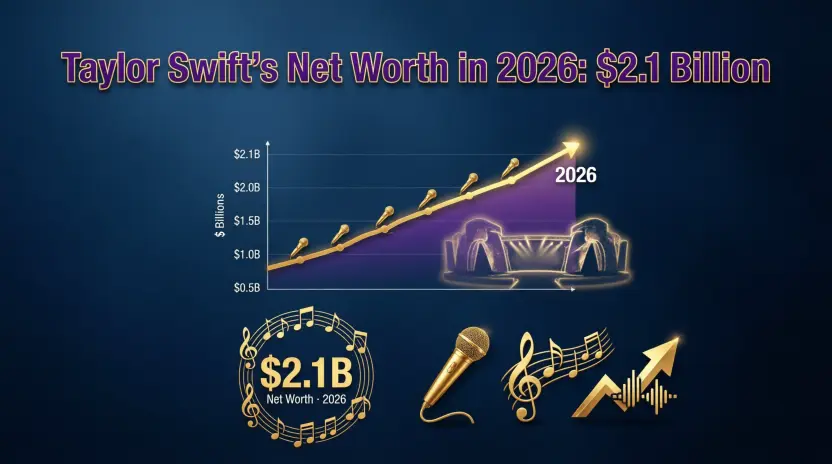
Taylor Swift’s journey from a teenage songwriter to one of the world’s wealthiest entertainers has become one of the most remarkable financial stories in modern music. But what is Taylor Swift’s net worth in 2026? Current Forbes estimates put her fortune at around $2 billion, placing her among the most financially successful musicians in history. Her wealth is not based on a single income source. Instead, it has been built through music sales, streaming royalties, touring, merchandise, her valuable music catalog, and real estate. Forbes says her fortune includes hundreds of millions from royalties and touring, a music catalog valued at hundreds of millions of dollars, and substantial property holdings.
The biggest acceleration in Swift’s wealth came during the Eras Tour, which generated more than $2 billion in ticket sales before accounting for other revenue such as merchandise. Her ownership of her music rights has also become increasingly important to her financial position. In 2025, Swift announced that she had reacquired the rights to her first six albums, giving her control over the recordings that helped launch her career. This article examines Taylor Swift’s estimated net worth in 2026, her major income sources, music catalog, touring success, real estate, and the factors behind her extraordinary financial growth.
Taylor Swift Net Worth at a Glance
| Category | Information |
| Full Name | Taylor Alison Swift |
| Profession | Singer, songwriter, musician, performer, producer |
| Country | United States |
| Industry | Music & Entertainment |
| Estimated Net Worth (2026) | $2 billion |
| Wealth Status | Billionaire, according to Forbes |
| Billionaire Since | October 2023, according to Forbes |
| Primary Wealth Sources | Music, touring, royalties, music catalog, real estate |
| Touring Wealth | Nearly $800 million attributed by Forbes to royalties and touring |
| Music Catalog Estimate | Approximately $600 million |
| Real Estate Estimate | Approximately $110 million |
| Eras Tour | Major contributor to Swift’s wealth; estimated gross exceeded $2 billion |
| Eras Tour Shows | 149 shows across 51 stadiums |
| Eras Tour Tickets Sold | More than 10 million |
| Music Ownership | In May 2025, Swift announced that she had reacquired the rights to her first six albums |
| Taylor’s Versions | Re-recorded albums helped Swift regain control over recordings from her early catalog |
| Career Revenue Model | Album sales, streaming, touring, songwriting, publishing/royalties and licensing |
| Real Estate Portfolio | High-value properties in locations including New York, Nashville, Rhode Island and Beverly Hills have contributed to her asset base |
| Awards & Recognition | 14 Grammy Awards listed by Forbes |
| Financial Status | Estimated; not a publicly audited personal balance sheet |
| Net Worth Methodology | Estimates can change with catalog valuations, property values, royalties, touring income and other assets |
| E-E-A-T Source | Forbes billionaire profile and financial reporting |
| Touring Data Source | Pollstar reported the Eras Tour’s final estimated gross at approximately $2.2 billion |
| Important Fact-Check Note | Tour gross revenue is not the same as Taylor Swift’s personal profit or net worth |
| 2026 Data Note | Forbes’ profile listed $2 billion as her real-time net worth as of September 11, 2026 |
The $2 billion figure is a Forbes estimate as of September 10, 2026, rather than a figure disclosed by Swift herself. Forbes’ methodology includes valuations of assets and accumulated earnings, meaning the estimate can change as asset values, music revenues, and other financial factors change.
How Did Taylor Swift Build Her Net Worth?
Taylor Swift built her fortune over a career spanning multiple stages of the music industry. Her income has not depended on one album, tour, or business activity. Instead, her wealth has developed through recorded music, songwriting, touring, royalties, ownership of valuable musical assets, and real estate.
Music and Songwriting
Music remains the foundation of Taylor Swift’s wealth. Her songwriting catalog has generated income through recordings, streaming, licensing, and other forms of music exploitation.
Swift’s financial position is also connected to the value of her catalog. Forbes currently estimates the catalog at approximately $600 million.
Because catalog valuations depend on expected future income, the figure is an estimate rather than a simple cash balance.
Touring Revenue
Concert touring has played a major role in Swift’s financial growth. The Eras Tour became one of the defining commercial events of her career and contributed substantially to the wealth estimates associated with her billionaire status.
Forbes specifically attributes Swift’s 2023 transition into billionaire territory to earnings from the Eras Tour and the value of her music catalog.
The important distinction is that tour revenue is not the same as personal profit. A tour generates significant gross revenue, but expenses such as production, venues, employees, transportation, taxes, and other costs must be considered before determining what ultimately contributes to personal wealth.
Royalties
Royalties are another important component of Swift’s estimated fortune. Forbes currently attributes nearly $800 million collectively to royalties and touring within its wealth calculation.
Her extensive catalog gives her multiple opportunities to generate continuing music-related income. However, individual royalty payments and annual personal income are not completely disclosed publicly, so exact yearly royalty earnings should be treated as not publicly verified unless supported by a specific financial disclosure.
Music Catalog Ownership and Value
One of the most important developments in Swift’s financial story has been her relationship with her music catalog.
Forbes estimates the value of her catalog at around $600 million.
Swift also announced in May 2025 that she had reacquired the rights to her first six albums, according to Forbes.
Owning valuable intellectual property can significantly affect an artist’s net worth because music catalogs can continue producing income long after their original release.
Real Estate
Real estate is another identifiable component of Taylor Swift’s estimated wealth.
Forbes estimates that Swift owns approximately $110 million in real estate.
Property values can change over time, which is another reason net-worth estimates should be viewed as snapshots rather than permanent figures.
Taylor Swift’s Net Worth Compared With Her Music Career
Swift’s wealth reflects the unusual economics of becoming a global recording superstar. Traditional artist income can come from album sales, streaming, touring, publishing, merchandise, licensing, and endorsements. In Swift’s case, the value of her own musical intellectual property is especially significant.
Her official website currently lists an extensive archive covering albums and eras including Debut, Fearless, Speak Now, Red, 1989, Reputation, Lover, folklore, evermore, Midnights, The Tortured Poets Department, The Life of a Showgirl, and the Eras Tour.
This large body of work helps explain why her financial profile extends beyond current concert income.
Why Do Taylor Swift Net Worth Estimates Vary?
Different websites can report different net-worth figures for the same celebrity. That does not necessarily mean one source is intentionally incorrect.
Several factors can create differences:
- Private assets are not fully disclosed.
- Music catalogs require valuation assumptions.
- Real-estate values change over time.
- Tour revenue is different from personal earnings.
- Taxes and expenses affect actual wealth.
- Different publications use different methodologies.
- Asset values can change between publication dates.
For that reason, the $2 billion Forbes estimate should be described as an estimated net worth, not as a confirmed audited personal fortune.
Is Taylor Swift a Billionaire?
Yes. Forbes reported that Taylor Swift became a billionaire in October 2023. Forbes attributed the milestone primarily to the financial impact of her music and performances, particularly the Eras Tour and the value of her music catalog.
By 2026, Forbes’ real-time profile lists her estimated net worth at $2 billion.
It is important to distinguish this from having $2 billion in cash. Net worth represents the estimated value of assets minus liabilities. Much of a celebrity’s estimated fortune can be tied up in intellectual property, investments, property, and other assets.
Taylor Swift’s Biggest Known Wealth Categories
| Wealth Category | Estimated Value / Role |
| Royalties & touring | Nearly $800 million combined in Forbes’ estimate |
| Music catalog | About $600 million |
| Real estate | About $110 million |
| Other wealth/assets | Remaining portion of overall estimated fortune |
| Estimated total net worth | About $2 billion |
These figures come from Forbes’ 2026 assessment and should be understood as valuation estimates, not independently audited figures.
What Makes Taylor Swift’s Wealth Different?
Swift’s financial story is notable because a substantial portion of her estimated wealth comes from music itself.
Forbes describes her as the first musician to reach its billionaire ranking primarily through songs and performances.
That distinction matters because many celebrity billionaires build fortunes through technology companies, investments, manufacturing, retail, or inherited businesses. Swift’s estimated fortune is instead closely associated with her career as a creative performer and the ownership/value of intellectual property generated by that career.
Taylor Swift Income Sources: How Does She Make Money?
Taylor Swift’s wealth comes from a combination of music royalties, touring, music ownership, merchandise, concert films, brand partnerships, and real estate appreciation. Because private contracts and personal financial statements are not fully public, individual income figures should be treated as estimates rather than audited earnings. Forbes currently estimates Swift’s net worth at about $2 billion, with nearly $800 million attributed to royalties and touring, an estimated $600 million music catalog, and approximately $110 million in real estate.
1. Music Royalties
Music royalties are one of the most important long-term sources of Taylor Swift’s income. Every time her songs are streamed, purchased, licensed, performed publicly, or used in certain commercial contexts, various rights holders can receive royalty payments.
Swift has an unusually large catalog spanning multiple eras of her career. Her albums include Taylor Swift, Fearless, Speak Now, Red, 1989, Reputation, Lover, folklore, evermore, Midnights, and The Tortured Poets Department, along with her re-recorded “Taylor’s Version” releases.
Her enormous streaming audience means older songs can continue generating revenue years after their original release. A successful catalog can therefore function differently from a traditional one-time paycheck: songs can potentially generate royalties repeatedly over many years.
Forbes includes nearly $800 million from royalties and touring within its estimate of Swift’s accumulated wealth. That figure combines two major categories rather than representing a single annual salary.
2. Music Catalog Ownership
Ownership of music rights is particularly important to Swift’s financial story.
In May 2025, Swift announced that she had reacquired ownership of her music, videos, concert films, album artwork, photography, unreleased songs, and other work. On her official website, she described the deal as bringing her entire body of music back under her ownership.
This is financially significant because ownership can allow an artist to participate more directly in the economic value generated by recordings and related intellectual property.
Swift’s experience with her early masters also helped make ownership a major theme of her career. Forbes previously reported that her first six albums had been sold to Shamrock after the earlier Big Machine transaction, and Swift responded by beginning the process of re-recording those albums.
The eventual reacquisition means the value of her catalog is now an important component of her overall wealth.
3. The Eras Tour
Touring has been another major source of Taylor Swift’s income.
The Eras Tour ran for 149 shows across 51 stadiums and became the highest-grossing tour ever according to Pollstar’s final estimate. Pollstar estimated approximately $2.2 billion in gross ticket sales and more than 10 million tickets sold.
It is important to distinguish tour gross revenue from Taylor Swift’s personal income. A $2.2 billion tour gross does not mean Swift personally received $2.2 billion. Touring involves stadiums, promoters, production, transportation, crew, insurance, taxes, commissions, and many other expenses.
Nevertheless, the scale of the tour created a huge economic opportunity. Forbes specifically identifies touring as one of the major contributors to Swift’s accumulated wealth.
The tour also created additional income opportunities through merchandise, ticket-related products, sponsorships, and the subsequent concert film.
4. Concert Film Revenue
Swift also benefited financially from the release of Taylor Swift: The Eras Tour concert film.
The movie was released in theaters in October 2023 and became a major commercial success. Pollstar reported that the concert film had earned approximately $261.6 million globally by early 2024.
Again, box-office revenue should not be confused with the artist’s personal profit. Theaters, distributors, production expenses, marketing, and other participants affect the final amount.
Nevertheless, a successful concert film gives an artist another way to monetize a tour after the live performances have ended. For Swift, the project extended the commercial life of the Eras Tour beyond stadium ticket sales.
5. Album Sales
Traditional album sales remain another component of Swift’s income.
Swift has sold millions of albums throughout her career, both physically and digitally. Her ability to maintain strong demand for new releases and re-recorded albums has created multiple revenue opportunities.
Physical formats such as CDs, vinyl records, and special editions can generate revenue beyond streaming. Swift has also frequently released different editions and collectible versions of albums, giving fans multiple purchasing options.
Her official website currently maintains an extensive archive of her albums and eras, including original albums and Taylor’s Version releases.
Album sales can also increase streaming activity, concert demand, merchandise sales, and catalog value, making a successful album commercially important beyond its initial sales.
6. Streaming Revenue
Streaming platforms provide another recurring income source.
Swift’s music is available across major digital music services, where streams can generate royalties through agreements involving the artist, songwriter, publisher, label, and other rights holders.
The exact amount Swift personally earns per stream cannot be calculated simply by multiplying streams by a fixed rate. Streaming economics are more complicated because payments depend on the platform, territory, rights involved, subscription revenue, agreements, and distribution arrangements.
For an artist with Swift’s catalog size and global audience, however, continuous streaming can provide a substantial long-term revenue stream.
Her older songs also continue to receive attention whenever they become popular on social media, appear in films or television, or are rediscovered by new listeners.
7. Taylor’s Version Releases
Swift’s re-recording strategy created another unusual source of income.
She released new versions of several earlier albums under the Taylor’s Version branding. These included Fearless (Taylor’s Version), Red (Taylor’s Version), Speak Now (Taylor’s Version), and 1989 (Taylor’s Version).
The strategy had both artistic and financial implications. Rather than simply relying on the commercial value of older recordings, Swift created new recordings that could generate their own sales and streaming activity.
Her official statement about reacquiring her music confirms that the success of the re-recorded albums and the Eras Tour helped her eventually buy back her music.
This demonstrates how control over intellectual property can influence an artist’s long-term financial position.
8. Merchandise Sales
Merchandise is another important part of Swift’s business ecosystem.
Fans can purchase clothing, accessories, collectibles, physical albums, special-edition products, and tour-related merchandise.
The scale of the Eras Tour provided an enormous merchandise opportunity because millions of fans attended shows or followed the tour online.
Merchandise revenue is not the same as pure profit. Manufacturing, shipping, fulfillment, employees, marketing, retail arrangements, and other costs reduce the amount ultimately retained by the business.
However, a globally recognized artist can sell merchandise to an enormous audience, creating a valuable business alongside music.
Swift’s official online presence includes a dedicated store operated by Taylor Nation and UMG-related entities, demonstrating the established commercial infrastructure surrounding her brand.
9. Brand Partnerships and Sponsorships
Swift has also earned money through commercial partnerships.
One documented example is her long-running relationship with Capital One. Pollstar reported that the partnership associated with the Eras Tour was reportedly worth $8 million to Swift and began in 2019.
Brand partnerships can involve advertising campaigns, promotional appearances, exclusive products, sponsorship arrangements, or event relationships.
The value of individual agreements can vary considerably, and not every private contract is publicly disclosed.
Because Swift has an exceptionally large international audience, companies can potentially gain substantial visibility by associating their products with her music and public brand.
10. Licensing and Intellectual Property
Licensing can provide another layer of income.
Swift’s music, name, image, recordings, compositions, and other intellectual property can have commercial value when used under appropriate agreements.
Music licensing can involve films, television programs, advertising, games, documentaries, and other media. Songwriting rights can also produce publishing income when compositions are used or performed.
The exact terms of individual licensing contracts are generally private, so precise annual income from licensing should not be presented as verified unless supported by a reliable disclosure.
Still, the size and longevity of Swift’s catalog make intellectual property one of the most important parts of understanding her overall financial position.
11. Songwriting Income
Taylor Swift is not simply a performer. She is also a songwriter and has writing credits across her catalog.
That distinction matters financially because songwriting creates a separate layer of intellectual-property rights from the income generated by performing or recording songs.
When compositions are streamed, sold, performed publicly, licensed, or otherwise exploited commercially, songwriting and publishing rights can generate revenue.
Swift’s songwriting has therefore been central to both her artistic career and her financial development.
Her early career established the foundation, while later albums expanded her catalog and created additional long-term revenue opportunities.
12. Touring Merchandise
Tour merchandise deserves separate attention because of the extraordinary scale of the Eras Tour.
A normal concert merchandise operation can involve T-shirts, hoodies, posters, accessories, albums, and collectibles. Swift’s tour expanded this model across an international stadium network.
Fans could purchase tour-specific items connected to individual eras and shows.
With more than 10 million tickets sold during the Eras Tour, the potential audience for merchandise was enormous. Pollstar’s reporting confirms the tour’s extraordinary attendance and $2.2 billion estimated gross.
The financial benefit is not limited to the amount fans spend at stadiums. Tour merchandise can also remain commercially relevant through online sales and post-tour releases.
13. Real Estate
Real estate represents another major component of Swift’s wealth.
Forbes estimates that her real estate holdings are worth around $110 million.
Unlike royalties or touring income, property value is generally an asset rather than regular earned income.
A property can appreciate over time, meaning its market value increases even when the owner is not actively generating revenue from it.
Swift has accumulated high-value residential properties in several U.S. markets during her career. These holdings contribute to her overall net worth calculation.
However, estimated property values should not be interpreted as cash sitting in a bank account. Real estate values can change according to market conditions, location, property improvements, and comparable sales.
14. Digital Music and Downloads
Digital music purchases were particularly important during Swift’s earlier career.
Before streaming became dominant, consumers frequently purchased individual songs and complete albums through digital stores.
Swift’s extensive catalog benefited from this transition period because she was already an established global artist when digital music became mainstream.
Although streaming now plays a much larger role in the industry, digital sales remain part of the historical revenue generated by her recordings.
More importantly, her catalog continues to have economic value because songs released years ago can still be purchased, streamed, licensed, and rediscovered.
15. Publishing Rights
Publishing rights are another important component of songwriter economics.
A songwriter’s composition and the sound recording of that composition are legally distinct forms of intellectual property. Revenue can therefore arise from different rights associated with the same song.
For Swift, writing or co-writing many of her songs gives her an economic interest beyond her role as a recording artist.
This is one reason why analyzing her net worth only through album sales would provide an incomplete picture.
Her songwriting catalog has accumulated value over nearly two decades, and the continuing popularity of her compositions provides opportunities for future royalties.
16. Global Fan Base
Swift’s global fan base is not technically an income source by itself, but it is a major driver behind many of her revenue streams.
Millions of listeners create demand for music.
Concert audiences create ticket revenue.
Fans purchase merchandise.
Streaming activity generates royalties.
Collectors purchase special editions.
Audiences watch concert films.
Brands can seek partnerships because of the reach associated with her name.
This interconnected business model helps explain why Swift’s income sources are so diversified.
The Eras Tour demonstrated the scale of this audience particularly clearly, with Pollstar reporting more than 10 million tickets sold across the tour.
17. Music Videos and Visual Content
Swift’s music-related visual projects can also contribute to her broader commercial ecosystem.
Music videos can increase song exposure, streaming activity, digital sales, and advertising value.
Some of her visual projects have also become part of her broader artistic brand.
Her official website identifies directed projects and maintains an archive covering different eras of her career.
While there is not enough public information to assign a precise annual dollar amount to music-video income, these projects can indirectly increase the commercial performance of her music.
18. Film and Entertainment Projects
Swift’s involvement in film has created additional commercial opportunities.
The Eras Tour concert film is the clearest example. Its global box-office performance showed that her audience could support a major theatrical release in addition to traditional music products.
She has also directed music-related projects and expanded her creative role beyond simply performing songs.
Film-related income can come from production, distribution arrangements, licensing, box-office participation, and other contractual terms.
Because those agreements are not necessarily public, it is more accurate to identify film as a potential and documented commercial channel rather than assign a precise annual income figure without evidence.
19. Brand Value
Taylor Swift’s name itself has become a major commercial asset.
A recognizable personal brand can support multiple businesses simultaneously: music, touring, merchandise, partnerships, intellectual property, and entertainment projects.
The financial significance of this brand can be seen in how quickly demand can form around new music, concert tickets, merchandise, and special releases.
However, brand value should not automatically be counted as cash income.
Instead, it helps explain why businesses associated with Swift can generate significant commercial activity.
20. The Business Behind Taylor Swift’s Wealth
The most useful way to understand Taylor Swift’s income is to look at the entire ecosystem rather than one paycheck.
Her financial model combines:
- Music royalties
- Songwriting and publishing
- Music catalog ownership
- Album sales
- Streaming
- Taylor’s Version releases
- Concert ticket revenue
- Tour merchandise
- Concert films
- Brand partnerships
- Licensing
- Real estate
- Other entertainment projects
Forbes’ 2026 estimate of approximately $2 billion reflects accumulated wealth rather than a single year’s salary. Forbes attributes nearly $800 million to royalties and touring, estimates her music catalog at about $600 million, and values her real estate at approximately $110 million.
Taylor Swift Income Sources: A Simple Breakdown
| Income Source | Financial Importance |
| Music royalties | Major long-term revenue source |
| Touring | Major source of accumulated wealth |
| Music catalog | Major asset |
| Album sales | Recurring commercial revenue |
| Streaming | Ongoing royalties |
| Taylor’s Version | New recordings and catalog revenue |
| Merchandise | Significant fan-driven business |
| Concert films | Additional entertainment revenue |
| Brand partnerships | Commercial income |
| Licensing | Intellectual-property revenue |
| Songwriting | Publishing and royalty income |
| Real estate | Major wealth-holding asset |
Is Taylor Swift’s $2 Billion Net Worth the Same as Her Annual Income?
No. This distinction is extremely important when writing a net-worth article.
A net worth estimate represents the estimated value of a person’s assets minus applicable liabilities. It does not mean that the person earned that amount during the year.
For example, Forbes currently estimates Swift’s wealth at approximately $2 billion, but that does not mean she received $2 billion in salary or cash income in 2026.
Similarly, the Eras Tour generated an estimated $2.2 billion in gross ticket sales, but that figure represents the tour’s total ticket revenue rather than Swift’s personal profit.
This distinction is essential for accurate financial reporting and helps avoid overstating celebrity earnings.
Why Taylor Swift’s Income Model Is Different
Swift’s financial growth illustrates the difference between being paid for creative work and owning valuable intellectual property.
A performer can earn a fee for appearing on a tour or recording an album. An artist who owns valuable songs and recordings can potentially continue earning from those assets long after the original work was created.
Swift’s decision to regain ownership of her music therefore has significance beyond personal artistic control.
Her official statement about buying back her music specifically highlighted ownership of her music, videos, concert films, album art, photography, and unreleased songs.
That broader ownership gives her control over a large collection of intellectual property that can potentially generate value for many years.
Final Thoughts on Taylor Swift’s Income Sources
Taylor Swift’s financial success is the result of multiple interconnected income sources rather than one unusually large salary. Music royalties, songwriting, catalog ownership, touring, merchandise, streaming, album sales, brand partnerships, entertainment projects, and real estate all contribute to the larger picture.
The Eras Tour demonstrated the extraordinary commercial scale of her live performances, with Pollstar estimating more than $2.2 billion in gross ticket sales and over 10 million tickets sold. Meanwhile, Forbes’ 2026 estimate places her net worth at approximately $2 billion, including major contributions from royalties and touring, her music catalog, and real estate.
For an SEO-focused net-worth article, the most important point is that these figures are estimates, not audited personal financial statements. Swift’s exact annual income is not fully public, so individual income figures should be presented as reported or estimated amounts rather than confirmed earnings. Her long-term wealth story is primarily about the combination of global music demand, intellectual-property ownership, successful touring, and the ability to turn a creative career into a diversified business ecosystem.
Frequently Asked Questions
1. What is Taylor Swift’s net worth in 2026?
Taylor Swift’s estimated net worth is about $2 billion, according to Forbes’ September 2026 real-time estimate.
2. Is Taylor Swift a billionaire?
Yes. Forbes reported that Swift became a billionaire in October 2023.
3. How did Taylor Swift become a billionaire?
Her wealth has been linked primarily to her music career, touring, royalties, and the value of her music catalog. Forbes specifically cited the Eras Tour and music catalog in its billionaire assessment.
4. How much is Taylor Swift’s music catalog worth?
Forbes estimates Taylor Swift’s music catalog at approximately $600 million.
5. How much does Taylor Swift have in real estate?
Forbes estimates her real-estate holdings at approximately $110 million.
6. Did the Eras Tour increase Taylor Swift’s net worth?
The Eras Tour was a major contributor to Swift’s financial growth. Forbes cited earnings from the tour as one of the reasons she reached billionaire status.
7. Is Taylor Swift’s $2 billion net worth confirmed?
No. $2 billion is an estimate, not a publicly audited personal balance sheet. Forbes provides the estimate using its own wealth-assessment methodology.
8. Does Taylor Swift still earn money from older songs?
Music catalogs can generate continuing revenue through recordings, streaming, publishing, licensing, and other uses. The exact amount Swift personally earns from individual older songs is not publicly verified.
9. Did Taylor Swift regain ownership of her earlier albums?
Forbes reported that Swift announced in May 2025 that she had reacquired the rights to her first six albums.
10. What is Taylor Swift’s main source of wealth?
Her wealth is primarily associated with music, touring, royalties, and the value of her music catalog, with real estate also forming a significant component of Forbes’ estimate.
Conclusion
Taylor Swift’s net worth in 2026 reflects nearly two decades of success in music, touring, songwriting, and business. Forbes estimates her wealth at around $2 billion, although this figure is an estimate rather than an audited personal financial statement. Her fortune comes from several major sources, including music royalties, album sales, streaming, songwriting, touring, merchandise, music catalog ownership, brand partnerships, and real estate.
The Eras Tour significantly expanded Swift’s financial profile, generating billions in gross ticket sales and attracting millions of fans worldwide. Her decision to regain ownership of her music has also strengthened the long-term value of her intellectual property. Importantly, net worth should not be confused with annual income, because asset valuations and business revenues are different from personal earnings.
Overall, Taylor Swift’s financial story demonstrates how artistic success, intellectual-property ownership, global touring, and diversified business interests can combine to create substantial long-term wealth.