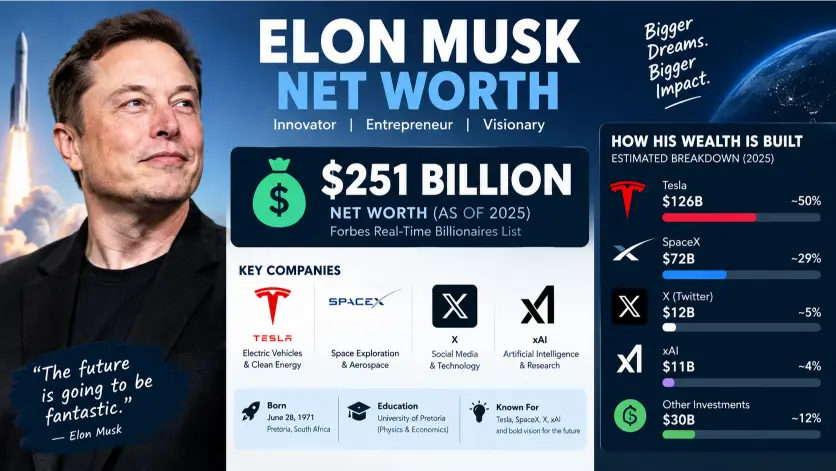
Elon Musk’s net worth in February 2026 became one of the biggest financial stories of the year, with his fortune moving sharply as the value of Tesla, SpaceX, and his other companies changed. Forbes estimated Musk’s wealth at approximately $775 billion on February 1, 2026, while its real-time estimate later reached $839.4 billion on February 6. These figures show why billionaire net worth should always be tied to a specific date and source rather than treated as a fixed amount.
Musk’s fortune is primarily connected to his ownership stakes and interests in companies including Tesla, SpaceX, xAI, X, Neuralink, and The Boring Company. Bloomberg also explains that billionaire wealth estimates can change daily because public-company shares and private-company valuations fluctuate. In this article, we examine Elon Musk’s February 2026 net worth, major assets, business interests, and wealth sources using publicly reported figures while clearly separating verified information from estimates.
Elon Musk Net Worth February 2026 at a Glance
| Category | Information |
| Estimated February 2026 Net Worth | Approximately 670billion–840 billion, depending on source and date |
| Forbes Figure, Feb. 6, 2026 | $839.4 billion |
| Bloomberg Figure, Feb. 20, 2026 | About $672 billion |
| Profession | Entrepreneur, investor, and business executive |
| Main Industries | Technology, aerospace, automotive, artificial intelligence, infrastructure, and neurotechnology |
| Major Companies | Tesla, SpaceX, xAI, Neuralink, The Boring Company, and X |
| Born | June 28, 1971 |
| Birthplace | Pretoria, South Africa |
| Nationality | South African-born entrepreneur with Canadian and U.S. citizenship |
| Education | Attended Queen’s University and the University of Pennsylvania |
| Early Business Career | Co-founded Zip2 and later co-founded X.com, which became part of PayPal |
| Tesla Role | Tesla CEO and a major shareholder; his wealth is strongly affected by Tesla’s stock value |
| SpaceX Role | Founder and CEO; SpaceX is privately held, so its valuation can significantly affect estimates of Musk’s wealth |
| AI Business | Founder of xAI, an artificial-intelligence company |
| Social Media Business | Acquired Twitter in 2022 and subsequently rebranded it as X |
| Neuralink | Co-founded Neuralink, focused on brain-computer interface technology |
| The Boring Company | Founder of the infrastructure and tunneling company |
| Primary Wealth Drivers | Equity ownership, private-company valuations, stock-price movements, and business holdings |
| Publicly Traded Wealth | Tesla shares and related financial interests contribute substantially to his publicly trackable wealth |
| Private Company Wealth | SpaceX, xAI, Neuralink, and other privately held interests are valued using estimates and private-market transactions |
| Net Worth Type | Estimated, not publicly audited |
| Why Estimates Differ | Forbes and Bloomberg use different valuation methods, asset assumptions, update schedules, and treatment of private-company holdings |
| Important EEAT Note | A billionaire’s net worth is not the same as cash in a bank account; most of Musk’s reported wealth is tied to ownership stakes and asset valuations |
| Data Accuracy Note | Net-worth figures can change substantially from day to day because publicly traded assets fluctuate and private-company valuations can change after financing or secondary-market transactions |
| Status | Alive |
| Best Editorial Practice | Present the February 2026 figures as source-specific estimates, rather than claiming that one figure represents a confirmed audited net worth |
Why Elon Musk’s Net Worth Was So Difficult to Calculate
Elon Musk’s wealth cannot be measured simply by adding up his bank accounts. Much of his estimated fortune comes from ownership interests in companies whose values fluctuate.
Tesla is the clearest example. Because Tesla is publicly traded, the market value of Musk’s shares can rise or fall whenever the stock price changes. A large movement in Tesla’s share price can therefore change his estimated wealth by billions of dollars.
SpaceX creates a different calculation problem. Unlike Tesla, SpaceX was privately held during February 2026. Its value had to be estimated using private transactions and financing information rather than a continuously quoted public-market price.
Musk also had interests in other privately held companies. Wealth trackers therefore had to make assumptions about the value of those businesses and the percentage of them attributable to Musk.
This explains why two reputable wealth publications could report very different estimates without either figure necessarily representing an audited statement of Musk’s personal finances.
Elon Musk Net Worth in February 2026: Forbes vs. Bloomberg
One of the most useful ways to understand the February 2026 figure is to compare the methodologies used by major wealth trackers.
Forbes reported on February 6, 2026, that Musk had an estimated net worth of $839.4 billion. Forbes identified him as the world’s wealthiest person at that point.
Bloomberg’s methodology produced a substantially lower figure around the middle of February. A February 20 report citing the Bloomberg Billionaires Index placed Musk’s wealth at approximately $672 billion.
| Source | February 2026 Figure | Important Context |
| Forbes | $839.4 billion | Reported Feb. 6, 2026 |
| Bloomberg estimate cited Feb. 20 | ~$672 billion | Different private-company valuation methodology |
| Confirmed audited personal net worth | Not publicly verified | No public audited statement establishes one exact number |
The difference does not mean Musk suddenly gained or lost nearly $170 billion in cash. Instead, it demonstrates how much private-company valuations and calculation methods can influence billionaire wealth estimates.
For readers searching for Elon Musk net worth February 2026, it is therefore more accurate to mention the source and date rather than presenting one number as an unquestionable fact.
SpaceX and Its Impact on Musk’s Wealth
SpaceX was one of the most important assets behind Musk’s estimated fortune.
In December 2025, Bloomberg reported that an insider share transaction valued SpaceX at approximately $800 billion. That valuation was particularly significant because SpaceX remained a private company and therefore did not have a public stock-market price.
Then, in February 2026, SpaceX announced that it would acquire Musk’s artificial-intelligence company xAI. Reports described the transaction as valuing the enlarged business at approximately $1.25 trillion.
However, the headline $1.25 trillion transaction valuation should not automatically be treated as the value of Musk’s personal stake.
Bloomberg’s wealth methodology explained that it calculated Musk’s ownership of the combined SpaceX-xAI business differently, using previous company valuations and ownership stakes. Bloomberg reported that Musk was calculated to own approximately 44% of the combined company under its methodology.
This is an important distinction for net-worth research: a company’s transaction valuation is not automatically the same thing as the value of one shareholder’s personal wealth.
Tesla Remained a Major Source of Elon Musk’s Wealth
Tesla has been central to Musk’s fortune for years.
Musk has been Tesla’s CEO since 2008, and his ownership of Tesla shares and stock options has represented a substantial part of his estimated wealth.
Because Tesla is publicly traded, its contribution to Musk’s estimated net worth can change rapidly. If Tesla shares rise, the estimated value of Musk’s holdings can increase. If the stock declines, his estimated fortune can fall even when he does not sell shares.
This is one reason billionaire net-worth figures should not be interpreted as annual salaries.
Musk’s estimated fortune represents the calculated value of his assets minus applicable liabilities. It does not mean that he receives hundreds of billions of dollars in annual income.
xAI and Artificial Intelligence
Artificial intelligence became increasingly important to Musk’s business portfolio.
xAI was founded by Musk as an artificial-intelligence company and developed Grok, an AI chatbot and related technology.
In February 2026, SpaceX’s acquisition of xAI significantly changed how the two businesses were viewed in relation to Musk’s wealth.
The transaction was reported at a $1.25 trillion valuation for the combined entity, although wealth calculations used by individual trackers could differ because Musk already controlled interests in both companies.
The deal also highlighted an important characteristic of Musk’s wealth: his businesses are interconnected across several high-growth technology sectors, including AI, aerospace, satellites and electric vehicles.
Other Companies Connected to Musk’s Fortune
Tesla and SpaceX were the dominant components of Musk’s estimated fortune, but they were not his only business interests.
Neuralink
Neuralink is a neurotechnology company founded by Musk and other individuals. Its work focuses on brain-computer interface technology.
Because Neuralink is privately held, its contribution to Musk’s net worth is based on estimated company valuations and his ownership rather than a public stock price.
The Boring Company
The Boring Company focuses on infrastructure and tunnel construction technology.
Like Neuralink, it is privately held, meaning outside wealth trackers must estimate its value when calculating Musk’s overall fortune.
X
Musk purchased Twitter in 2022 for approximately $44 billion and later renamed the company X.
The value of X has been subject to changing private-market estimates. Consequently, it is difficult for outside observers to determine its exact contribution to Musk’s personal wealth at any particular date.
How Elon Musk Built His Fortune
Musk’s wealth developed over several decades rather than coming from a single company.
Zip2
One of Musk’s early major entrepreneurial successes was Zip2, an internet company he co-founded in the 1990s.
The company was eventually sold, providing Musk with capital for subsequent ventures.
X.com and PayPal
Musk later founded X.com, an online financial-services company that became associated with what eventually developed into PayPal.
eBay acquired PayPal in 2002 in a deal valued at approximately $1.5 billion.
The transaction provided Musk with substantial capital that helped finance his later ventures.
SpaceX
Musk founded SpaceX in 2002 with ambitions centered on reducing the cost of space transportation and eventually enabling human settlement beyond Earth.
The company became one of the most valuable privately held businesses in the world.
Its increasing valuation became a major factor in Musk’s rise in estimated wealth.
Tesla
Musk joined Tesla in its early development and became its CEO in 2008.
Tesla’s expansion from a niche electric-vehicle manufacturer into a major global automotive and energy company played a major role in the growth of Musk’s paper wealth.
Is Elon Musk’s February 2026 Net Worth Confirmed?
No. Elon Musk’s exact February 2026 net worth was not publicly verified through an audited personal financial statement.
Figures published by Forbes, Bloomberg and other financial publications are estimates.
These estimates generally consider:
- Publicly traded stock holdings
- Private-company ownership
- Company valuations
- Stock options
- Other reported assets
- Debt and liabilities
- Foreign-exchange movements
- Changes in market prices
Different assumptions can produce significantly different results.
Therefore, readers should avoid describing $839 billion, $672 billion, or any other February 2026 figure as a confirmed cash balance.
Why Billionaire Net Worth Changes So Quickly
Musk’s estimated fortune can change by billions of dollars without him receiving or spending billions in cash.
Suppose the market value of a billionaire’s public-company shares rises sharply. The estimated value of the person’s assets increases even if the person does not sell a single share.
Private-company valuations work differently. A new investment round or secondary share transaction can establish a higher or lower implied valuation. Wealth trackers may then adjust their estimates.
This is particularly relevant to Musk because a large part of his fortune has historically been connected to privately held companies such as SpaceX.
Elon Musk’s Major Wealth Drivers in February 2026
| Wealth Driver | Public/Private | Relevance to Net Worth |
| Tesla | Public | Major source of estimated wealth through shares and options |
| SpaceX | Private | Major source; valuation based on private-market information |
| xAI | Private | Important AI-related asset before/through February merger |
| X | Private | Value based on private-company estimates |
| Neuralink | Private | Estimated value contributes to broader wealth calculations |
| The Boring Company | Private | Smaller privately held business interest |
| Cash & Other Assets | Mixed | Included differently depending on wealth methodology |
Elon Musk Net Worth Timeline
Musk’s financial story is closely tied to the growth of his companies.
| Period | Major Wealth Development |
| 1990s | Zip2 provided an early entrepreneurial exit |
| 2002 | PayPal was acquired by eBay |
| 2002 | SpaceX was founded |
| 2000s | Musk became increasingly involved with Tesla |
| 2010s | Tesla’s public-market value expanded substantially |
| 2020s | Tesla and SpaceX became the principal drivers of Musk’s estimated wealth |
| 2022 | Musk acquired Twitter |
| 2023 | Twitter was renamed X |
| 2025 | SpaceX reached an approximately $800 billion valuation in an insider share transaction |
| February 2026 | SpaceX announced its acquisition of xAI |
| February 2026 | Major wealth trackers continued to place Musk at the top of global billionaire rankings |
What Made February 2026 Especially Important?
February 2026 was significant because Musk’s business empire underwent a major structural change.
SpaceX’s acquisition of xAI connected two of Musk’s most important privately held technology businesses: aerospace and artificial intelligence.
The reported transaction valued the combined company at approximately $1.25 trillion. That figure attracted considerable attention because it illustrated the scale of Musk’s private-company holdings.
At the same time, wealth estimates remained dependent on methodology. Bloomberg’s calculations did not simply take the $1.25 trillion headline valuation and assign the resulting amount directly to Musk.
This distinction is essential when writing about Musk’s February 2026 net worth.
Elon Musk Income Sources and How He Built His Wealth
Elon Musk’s wealth comes from a combination of company ownership, stock holdings, performance-based compensation, private-company valuations, and entrepreneurial investments. Unlike a traditional executive whose wealth may be primarily connected to an annual salary, Musk’s financial position has historically been closely tied to the value of the businesses he owns or controls.
By February 2026, his major wealth-producing interests included SpaceX, Tesla, xAI, X, Neuralink, and The Boring Company. The exact value of these holdings can change substantially because Tesla is publicly traded while several other companies are privately valued. Forbes reported that SpaceX’s acquisition of xAI in February 2026 valued the combined business at about $1.25 trillion and estimated that the transaction increased Musk’s fortune by approximately $84 billion.
It is therefore important to distinguish between cash income and paper wealth. When the market value of shares rises, Musk’s net worth can increase even though he has not received that amount as cash income.
Tesla Is a Major Source
Because Tesla is publicly traded, the value of Musk’s Tesla holdings can change every trading day. A rise in Tesla’s share price can increase the estimated value of his stake, while a decline can reduce it.
This creates an important distinction between net worth and annual income. If Tesla stock increases by billions of dollars in market value, Musk does not necessarily receive billions of dollars in cash. Instead, the estimated value of his ownership rises.
Tesla Performance-Based Compensation
Musk has also received large performance-based equity awards from Tesla. Tesla’s filings show that its 2025 CEO Performance Award involved substantial equity incentives tied to performance conditions. The company’s filing reported a grant of 423,743,904 shares under the 2025 CEO Performance Award, with a reported grant-date value of approximately $132.3 billion.
This does not mean Musk immediately received $132.3 billion in cash. Equity awards are subject to specific vesting and performance conditions.
The distinction matters when discussing Musk’s “income.” A performance award can represent enormous potential compensation without being equivalent to money deposited into a bank account.
Tesla Shares and Long-Term Wealth
Musk’s Tesla ownership has historically been an important contributor to his overall wealth. As the company’s valuation changes, the estimated value of his stake changes as well.
This is one reason estimates of his net worth can differ between publications and between different dates.
2. SpaceX and Its Growing Private Valuation
Unlike Tesla, SpaceX was privately held during the February 2026 period discussed here, meaning its valuation was determined through private transactions and financing activity rather than a continuously quoted public stock price.
Forbes reported in February 2026 that Musk owned an estimated 42% stake in SpaceX before the company’s acquisition of xAI, based on a transaction that valued SpaceX at approximately $800 billion.
That illustrates how private-company valuation can have a huge impact on Musk’s estimated net worth.
Starlink’s Role in SpaceX
Starlink has become an important part of SpaceX’s business because it provides satellite internet services to customers in multiple markets.
As Starlink’s customer base, infrastructure and commercial operations expand, the value attributed to SpaceX can influence the estimated value of Musk’s ownership stake.
However, the company’s valuation should not automatically be treated as Musk’s personal income. It represents the estimated value of the business and, consequently, the value attributed to his ownership interest.
SpaceX Launch Business
SpaceX also generates revenue through launch services and contracts involving government and commercial customers.
Its Falcon rockets and other space-related operations form an important part of the company’s business model.
Again, company revenue should not be confused with Musk’s personal income. SpaceX’s revenue belongs to the company, while Musk’s personal wealth is primarily connected to his ownership interest and the valuation assigned to that interest.
3. xAI and Artificial Intelligence
Building an AI Company
Artificial intelligence became another major component of Musk’s business interests through xAI.
xAI was created as an artificial-intelligence company associated with Musk, and its valuation became increasingly important to calculations of his wealth.
In early February 2026, SpaceX acquired xAI in a transaction that Forbes said valued the combined company at approximately $1.25 trillion. Forbes estimated that the transaction increased Musk’s fortune by around $84 billion.
This event demonstrates how corporate transactions can rapidly change billionaire wealth calculations.
xAI’s Private Valuation
Before the SpaceX transaction, Forbes reported that Musk held an estimated 49% stake in xAI, based on a private funding round that valued xAI at approximately $250 billion.
The percentage and valuation should be treated as estimates for the relevant period rather than as a permanent figure.
Private-company ownership is particularly difficult to value precisely because there is no public market price for every share.
AI as a Long-Term Wealth Component
The growth of artificial intelligence also created new opportunities for Musk’s business portfolio.
Rather than generating a traditional salary from xAI, the major financial significance for Musk was his ownership interest and the valuation assigned to the company.
This is another example of why the phrase “income source” should be used carefully when discussing billionaire wealth.
4. X and Social Media Business Interests
Musk’s Acquisition of Twitter
Another important part of Musk’s business history is Twitter, which he acquired in 2022 and later rebranded as X.
The acquisition created a major technology and social-media asset within his broader business portfolio.
Musk’s financial exposure to X was different from his Tesla position because X was privately held. Consequently, its value could not be tracked through a public stock exchange in the same way as Tesla.
X and xAI Combination
Forbes reported that xAI and X had previously been combined under a new parent company, before the later SpaceX acquisition of xAI in February 2026.
This series of corporate transactions made Musk’s technology portfolio increasingly interconnected.
The value attributed to X and xAI could therefore affect assessments of Musk’s overall wealth, although private-company valuations remain estimates rather than continuously observable market prices.
5. Performance-Based Stock Awards
Musk’s Compensation Model Is Different
One of the most unusual aspects of Musk’s financial profile is the importance of performance-based equity compensation.
Instead of relying primarily on a large fixed annual salary, Musk’s compensation arrangements have included equity awards connected to ambitious company performance targets.
Tesla’s regulatory filings provide evidence of the scale of these awards. Its 2025 filing lists major equity awards for Musk, including the 2025 CEO Performance Award.
Why Stock Awards Matter
A stock award can potentially become extremely valuable if the company’s market capitalization increases significantly.
However, it may also have conditions that must be satisfied before the shares fully vest or become economically available.
Therefore, reporting the headline value of an award without explaining its conditions can give readers a misleading impression of Musk’s immediately available income.
Future Value Versus Current Income
For net-worth reporting, there are three different concepts worth separating:
- Current market value
- Potential future compensation
- Cash income actually received
These figures can be dramatically different.
For readers researching Elon Musk’s February 2026 wealth, this distinction provides a more accurate picture of how his fortune works.
6. Neuralink
Musk’s Brain-Computer Interface Company
Neuralink is another company associated with Musk and forms part of his broader technology portfolio.
The company is developing brain-computer interface technology designed to connect neural activity with computers and other devices.
Unlike Tesla, Neuralink does not have a public stock price that allows investors to calculate its market value every second.
Its private valuation therefore depends on financing activity, transactions and other available information.
Neuralink and Musk’s Net Worth
Musk’s interest in Neuralink can contribute to estimates of his wealth when analysts assign a value to his ownership.
However, because private-company valuations can differ between transactions, the value attributed to Musk’s Neuralink interest should be regarded as an estimate rather than a confirmed cash amount.
This is particularly important when constructing a February 2026 net-worth table.
7. The Boring Company
Tunneling and Infrastructure
The Boring Company represents another entrepreneurial venture associated with Musk.
Its focus includes tunnel construction and transportation infrastructure.
Like several of Musk’s other privately held companies, The Boring Company does not provide investors with a continuously changing public share price.
As a result, its contribution to Musk’s net worth is generally based on private valuation estimates.
Private Equity Value
If a private company raises capital at a particular valuation, that transaction can provide analysts with a reference point for calculating the approximate value of an owner’s stake.
However, such a valuation does not necessarily mean that the owner could immediately sell the entire stake for that amount.
This distinction is essential when discussing billionaire wealth.
8. Early PayPal and Entrepreneurial Wealth
The Sale of Zip2
Musk’s wealth-building story began before Tesla and SpaceX.
One of his earliest major entrepreneurial ventures was Zip2, a software company he co-founded.
Building Capital for Future Ventures
The capital and entrepreneurial experience from his earlier businesses helped him move into larger technology and transportation ventures.
This created the foundation for the companies that later became much more important to his overall wealth.
9. PayPal and the Next Stage of His Wealth
From X.com to PayPal
PayPal’s growth created another major entrepreneurial milestone for Musk.
Reinvestment Into New Companies
The capital generated from PayPal helped Musk finance subsequent ventures, including SpaceX and other technology projects.
This is a significant part of understanding his wealth-building process.
Rather than relying on one long-term salary, Musk repeatedly used capital from earlier ventures to fund businesses with potentially much larger future valuations.
10. Investment and Ownership Strategy
Musk’s Wealth Is Closely Linked to Equity
A major theme throughout Musk’s financial history is ownership.
His wealth has generally been connected to the value of the companies he owns or has substantial interests in.
That means his financial position can change much faster than the income of someone earning a fixed salary.
For example, a major change in Tesla’s share price can alter the value of his Tesla holdings, while a new private valuation for SpaceX can change the estimated value of his SpaceX interest.
Concentrated Ownership
Musk has maintained significant interests in several businesses rather than simply holding a diversified portfolio of conventional investments.
This makes his estimated wealth particularly sensitive to movements in the valuations of those companies.
11. Corporate Transactions as a Source of Wealth Growth
The SpaceX-xAI Transaction
The February 2026 SpaceX-xAI transaction provides one of the clearest examples of how Musk’s wealth can change without a conventional salary payment.
Forbes reported that the transaction valued the combined company at approximately $1.25 trillion and estimated Musk’s post-transaction ownership at around 43%, worth roughly $542 billion according to its calculation.
This was a valuation event rather than a normal paycheck.
Why Corporate Deals Affect Net Worth
When one company acquires another, the transaction establishes new reference points for the value of the businesses involved.
If Musk owns a substantial portion of those companies, analysts can use the transaction valuation to estimate the value of his stake.
That can produce a large change in his reported net worth even if Musk does not sell shares or receive an equivalent cash payment.
12. Tesla’s Future Performance Awards
Long-Term Incentives
Musk’s Tesla compensation also includes long-term performance incentives.
The structure of these awards means that significant future compensation depends on Tesla meeting specified performance conditions.
Tesla’s SEC filings document the company’s equity awards and related vesting arrangements.
This creates a potential future source of wealth rather than guaranteed current income.
Why These Awards Are Important
Long-term equity compensation aligns the financial value of an executive’s award with the company’s performance under the specified plan.
For readers calculating Musk’s net worth, it is therefore useful to distinguish between:
Vested shares: equity that has satisfied applicable vesting requirements.
Unvested awards: equity that remains subject to conditions.
13. Income From Business Leadership
CEO and Executive Roles
Musk has held leadership roles across multiple companies.
However, describing his entire wealth as “CEO income” would be misleading.
His financial profile is dominated by ownership interests and equity compensation rather than a conventional executive paycheck.
Tesla’s filings provide detailed information about his equity-based compensation, illustrating the importance of stock awards within his compensation structure.
Salary Versus Equity
A traditional executive might receive:
- Base salary
- Cash bonus
- Stock awards
- Other benefits
Musk’s compensation structure has placed unusually strong emphasis on equity and performance-based awards.
That makes his financial situation more dependent on business valuations than on annual salary.
14. Licensing and Business Relationships
Companies Connected Through Commercial Agreements
Musk’s companies also have commercial relationships with one another.
Tesla’s SEC filings disclose business dealings involving affiliated entities such as SpaceX, xAI and The Boring Company.
These transactions demonstrate that Musk’s business empire is not simply a collection of completely separate companies.
Some entities provide products, services or support to others.
However, revenue generated by one company should not automatically be classified as Musk’s personal income.
Corporate revenue remains company revenue unless it is distributed to an owner through mechanisms such as salary, dividends, sales proceeds or other transactions.
15. How Musk’s Net Worth Actually Grows
Appreciation Is More Important Than Salary
The biggest factor behind Musk’s enormous net worth is generally appreciation in the value of his ownership stakes.
Consider a simplified example.
If an entrepreneur owns 20% of a company valued at $100 billion, that stake is worth approximately $20 billion.
If the company later becomes worth $200 billion, the same 20% stake would theoretically be worth approximately $40 billion.
The entrepreneur has gained $20 billion in paper wealth without necessarily receiving $20 billion in cash.
This is broadly the type of mechanism that helps explain billionaire wealth calculations.
Public and Private Companies Work Differently
Tesla’s value can be observed through its publicly traded shares.
SpaceX, xAI and other private businesses require valuation estimates based on financing rounds, transactions or other available evidence.
Therefore, different wealth publications can report different figures on the same day.
16. Why Elon Musk’s Income Is Difficult to Calculate
Net Worth Is Not the Same as Annual Income
There is no single reliable public figure that represents Musk’s total annual “income” from every company and investment.
That is because his wealth consists largely of assets whose value changes over time.
A net-worth estimate may include:
- Tesla shares
- Tesla equity awards
- SpaceX ownership
- xAI-related ownership
- X-related interests
- Neuralink interests
- The Boring Company interests
- Other investments and assets
The value of these holdings can change independently of cash income.
Different Sources Produce Different Estimates
Forbes, Bloomberg and other financial publications may use different methodologies, market prices, valuation dates and assumptions.
For this reason, a high-quality net-worth article should always specify:
Source + date + methodology + whether the figure is estimated.
That approach is more transparent than presenting one number as permanently accurate.
17. Elon Musk’s Main Income and Wealth Sources at a Glance
| Income / Wealth Source | How It Contributes |
| Tesla | Shares and performance-based equity |
| SpaceX | Ownership stake and private-company valuation |
| Starlink | Part of SpaceX’s commercial value |
| xAI | Ownership interest and AI-company valuation |
| X | Private-company ownership interest |
| Neuralink | Private-company equity interest |
| The Boring Company | Private-company ownership |
| Tesla Compensation | Performance-based stock awards |
| PayPal | Historical entrepreneurial proceeds |
| Zip2 | Early entrepreneurial proceeds |
| Other Investments | Additional assets and business interests |
18. Final Look at Elon Musk’s Income Sources
Elon Musk’s financial story is fundamentally different from that of a celebrity who earns most of their money through movies, music, sponsorships or appearances. His wealth is heavily connected to ownership and equity appreciation.
Tesla has been an important source of publicly measurable equity wealth, while SpaceX became an increasingly significant component of his fortune as its private valuation expanded. xAI added another major technology asset, and the February 2026 SpaceX acquisition of xAI created a particularly important valuation event. Forbes estimated that the transaction increased Musk’s fortune by approximately $84 billion and placed the combined company at a valuation of about $1.25 trillion.
His earlier involvement with Zip2 and PayPal also helped provide the capital used to build later ventures. Meanwhile, Tesla’s performance-based compensation provides another potential source of future equity wealth, although awards should not be treated as immediate cash income.
For Elon Musk Net Worth February 2026, the most accurate way to describe his income sources is therefore to focus on company ownership, stock appreciation, equity compensation, private-company valuations, and entrepreneurial proceeds, while clearly separating estimated wealth from actual cash income.
Elon Musk Net Worth 2026: Income Sources
Elon Musk’s wealth comes from a combination of entrepreneurship, company ownership, stock-based compensation, investments, and the rising or falling valuations of businesses connected to him. Unlike a traditional employee who receives most of their wealth through an annual salary, Musk has historically accumulated much of his fortune through equity. This distinction is important when discussing Elon Musk’s income sources in 2026, because the amount his companies generate in revenue is not the same as the amount Musk personally earns.
His financial position is particularly unusual because he has significant interests in businesses operating across electric vehicles, energy storage, aerospace, artificial intelligence, social media, tunneling infrastructure, and neurotechnology. Tesla remains one of the most visible sources of his publicly measurable wealth, while SpaceX has become another major component. In 2026, SpaceX also changed the way its value could be measured after becoming publicly traded. SpaceX priced its initial public offering at $135 per share in June 2026 and subsequently disclosed that the IPO generated approximately $85.7 billion in gross proceeds.
For readers researching Elon Musk net worth 2026, it is therefore more accurate to examine his wealth through individual income and asset channels rather than assuming that his net worth represents money sitting in a bank account.
1. Tesla Stock and Ownership
Tesla is one of the most important components of Elon Musk’s financial profile.
Musk became closely associated with Tesla during its early development and has served as the company’s chief executive since 2008. His Tesla ownership gives him exposure to changes in the company’s market value. When Tesla shares rise, the market value of Musk’s holdings can increase by billions of dollars. When the shares fall, his estimated wealth can decline by a similar magnitude.
According to Tesla’s SEC filing covering ownership at the end of 2025, Musk beneficially owned approximately 717.1 million Tesla shares, equivalent to 20.3% of the company under the filing’s methodology.
This is an important distinction. Musk does not receive the entire increase in Tesla’s market capitalization as personal income. Instead, a higher Tesla share price increases the market value of the shares he owns.
For example, if the market price of Tesla stock increases substantially while Musk retains his shares, his paper wealth can rise even though he has not sold those shares or received an equivalent amount of cash.
Why Tesla stock matters to Musk’s wealth
Public-company shares are relatively easy for wealth trackers to value because the stock has a market price. Forbes and Bloomberg therefore incorporate Tesla’s share price into their billionaire calculations.
Bloomberg explains that its billionaire index values publicly traded stakes using the most recent closing prices and updates its figures every business day. This means Musk’s reported net worth can change without him receiving a paycheck or selling an asset.
This is one reason daily billionaire rankings should not be interpreted as annual salary statements.
2. Tesla CEO Compensation
Another important income source is Musk’s compensation from Tesla.
Musk’s Tesla compensation has historically been structured very differently from the salary package of a conventional corporate executive. Instead of relying primarily on a large fixed cash salary, Tesla has used performance-based equity awards.
This means the potential value of Musk’s compensation can be extremely large while the actual economic value depends on whether specified corporate and market targets are achieved.
Tesla’s 2025 reporting also illustrates why compensation and net worth should not be confused. Reports surrounding the company’s 2025 executive compensation described a very large stock-based compensation figure connected to Musk’s long-term award arrangements. However, such figures can represent the accounting value of awards rather than cash paid directly to Musk.
That distinction is essential for an accurate net-worth article.
Stock compensation versus cash salary
A cash salary is relatively straightforward:
Employer pays executive → executive receives cash → cash becomes personal income.
Stock compensation works differently:
Company grants shares or options → conditions must be satisfied → value depends on the stock price and award terms.
Consequently, a reported compensation value can be very different from money Musk can immediately spend.
Tesla’s long-term compensation arrangements have been linked to ambitious performance targets, meaning their ultimate value depends on company performance and the conditions attached to the awards.
For SEO content about Elon Musk, it is therefore better to describe Tesla compensation as a potential and realized equity-based wealth source, rather than simply calling the entire headline figure Musk’s annual salary.
3. SpaceX Ownership
SpaceX has become one of the most significant sources of Elon Musk’s wealth.
Founded in 2002, SpaceX operates in the aerospace and space-technology sector and has developed rockets, spacecraft, satellite communications, and related infrastructure.
For many years, SpaceX was privately held. That meant its valuation depended largely on private financing rounds, secondary transactions, and estimates from financial publications.
That changed dramatically in 2026.
SpaceX completed its initial public offering in June 2026. The company announced that its IPO priced shares at $135 each, and the offering ultimately generated approximately $85.7 billion in gross proceeds. Its shares began trading under the ticker SPCX.
This created a publicly observable market price for SpaceX shares.
Why SpaceX is so important
Bloomberg’s billionaire profile states that Musk’s fortune is mainly derived from his stakes in SpaceX and Tesla.
Reuters reported in August 2026 that Musk disclosed a 48.4% SpaceX stake as of June 30, 2026, with the value of that stake exceeding $900 billion at the market prices cited in that report.
This illustrates how rapidly Musk’s wealth can change.
If SpaceX shares appreciate, the value of Musk’s stake can increase substantially. If the stock declines, the opposite happens.
Again, this does not mean Musk receives hundreds of billions of dollars in annual cash income. The majority of that value represents ownership of an asset.
4. SpaceX Revenue and Business Operations
Musk’s connection to SpaceX also gives him indirect exposure to the company’s operating businesses.
SpaceX generates revenue from multiple activities, including launch services and satellite connectivity.
One of its best-known businesses is Starlink, which provides satellite internet services to customers in different markets.
SpaceX’s launch business is another important part of its commercial operation. The company develops and operates launch vehicles and spacecraft and sells launch-related services.
As the owner of a substantial equity stake, Musk can benefit financially when these businesses increase the underlying value of SpaceX.
However, it is not accurate to take SpaceX’s total corporate revenue and call it Musk’s personal income.
A company’s revenue must first cover operating costs, salaries, research and development, infrastructure, financing costs, taxes, and other expenses. Only the remaining profits, distributions, or changes in equity value can ultimately affect an owner’s personal financial position.
5. Starlink
Starlink represents another major business connected to Musk’s wealth through SpaceX.
The satellite-internet service operates as part of the SpaceX ecosystem and uses a large constellation of satellites to provide internet connectivity.
Its importance to Musk’s wealth comes from the fact that Starlink contributes to the overall economic value of SpaceX.
A successful subscription-based business can create recurring revenue, while growth in customers and infrastructure can influence investors’ expectations for the company’s future value.
For Musk, the financial benefit is therefore primarily connected to ownership of SpaceX, rather than a separate personal Starlink salary.
This distinction matters because many online articles list “Starlink income” as though Musk personally receives customer subscription payments. He does not. Customers pay the company for its services, and the company’s financial performance can influence the value of Musk’s ownership stake.
6. xAI and Artificial Intelligence
Artificial intelligence is another important part of Musk’s business portfolio.
Musk founded xAI, an artificial-intelligence company associated with the development of Grok and large-scale AI infrastructure.
xAI has attracted substantial outside investment. In January 2026, xAI announced that it had completed a $20 billion Series E funding round. The company said the financing would help expand its computing infrastructure and AI development.
Earlier, xAI announced a $6 billion Series C financing round in December 2024.
How xAI can contribute to Musk’s wealth
A private company’s fundraising can establish or imply a valuation.
Suppose an investor buys a percentage of a company at a particular valuation. That transaction can provide evidence of what the market is willing to pay for the company at that point in time.
If Musk owns a substantial stake, a higher company valuation can increase the estimated value of his stake.
However, this is not necessarily cash income.
For example:
xAI valuation increases → value of Musk’s ownership may increase → estimated net worth rises.
That is different from:
xAI pays Musk $10 billion in salary → Musk receives $10 billion cash.
The first mechanism is much closer to how billionaire wealth generally works.
7. Grok and AI Products
Grok is another potential source of long-term business value.
AI companies can generate revenue through consumer subscriptions, enterprise products, API access, licensing, advertising-related arrangements, and other commercial services.
As xAI develops its AI products, commercial adoption could contribute to the company’s revenue and valuation.
For Musk personally, the financial connection depends on his ownership stake and the structure of the company.
Because private-company financial information is generally less extensive than public-company reporting, estimates about personal income from xAI should be treated cautiously unless supported by company filings or other reliable documentation.
8. X and Social Media Business
Another part of Musk’s business portfolio is X, formerly known as Twitter.
Musk acquired Twitter in 2022 for approximately $44 billion and later renamed the company X.
The platform generates or has generated revenue from advertising, subscriptions, data-related services, and other commercial activities.
However, estimating Musk’s personal income from X is difficult because corporate revenue is not equivalent to personal income.
If X generates advertising revenue, that money belongs to the business. The company must then pay operating expenses and other obligations.
Musk can potentially benefit through the value of his ownership stake or through financial transactions involving the company.
This is another reason why a net-worth article should avoid stating a specific annual “X salary” unless it is publicly documented.
9. X Premium and Subscription Revenue
Subscription services represent another potential business revenue stream associated with X.
The platform offers paid features and subscription products that can generate recurring revenue.
These products may include enhanced account functionality and other services.
From a wealth perspective, the important question is not simply how much users pay for subscriptions. The more relevant question is how much revenue and profit those subscriptions generate for the company and how that affects the value of Musk’s ownership interest.
A successful recurring-revenue model can increase the financial value of a technology platform.
However, without audited personal financial statements, it would be misleading to convert X’s subscription revenue into a specific amount of Musk’s personal annual income.
10. Advertising Revenue From X
Advertising has historically been an important source of revenue for social-media platforms.
X can generate advertising income when companies pay to display promotional material to users.
Again, advertising revenue belongs to the company rather than directly to Musk.
The financial chain can be summarized as:
Advertisers → X revenue → company expenses and profitability → company valuation → Musk’s ownership value.
This distinction is particularly important when discussing billionaire wealth.
The same principle applies to Tesla, SpaceX, and xAI.
A company’s revenue should never automatically be described as the founder’s income.
11. Neuralink
Neuralink is another company founded by Musk and represents his exposure to the neurotechnology industry.
The company is developing brain-computer interface technology.
Neuralink is a private business, so its valuation and Musk’s exact economic interest can be more difficult for outside observers to calculate than his publicly disclosed Tesla holdings.
If Neuralink raises capital at a higher valuation, the implied value of existing ownership stakes can increase.
Likewise, if the company achieves important technological or commercial milestones, investor expectations can change.
For Musk, this represents a potential long-term wealth source rather than a conventional salary stream.
Because detailed personal ownership and financial information may not be publicly available, precise annual income figures attributed to Neuralink should not be presented as confirmed facts.
12. The Boring Company
The Boring Company is another business associated with Musk.
The company focuses on tunneling and transportation infrastructure.
Its business model differs significantly from Tesla and SpaceX, but it still contributes to Musk’s broader portfolio of private-company assets.
The company’s valuation can influence estimates of Musk’s overall wealth if he retains a substantial ownership interest.
Because it is not valued through a continuously traded public stock in the same way as Tesla, estimates can vary depending on the information used.
This is one of the reasons billionaire wealth estimates from different organizations can differ significantly.
13. Investment Gains From Tesla
Another way Musk can increase his wealth is through appreciation of his existing investments.
Investment gains do not necessarily involve selling anything.
For example, if Musk owns Tesla shares worth $100 billion and those shares rise by 10%, the theoretical market value of the position becomes approximately $110 billion.
He has not necessarily received $10 billion in cash.
Nevertheless, wealth-tracking organizations may report an approximately $10 billion increase in his net worth, assuming no other major changes.
This is called unrealized appreciation.
Unrealized gains are a major reason why Musk’s estimated wealth can move dramatically during periods of significant stock-market volatility.
14. Stock Options
Stock options have historically played an important role in Musk’s compensation arrangements.
An option gives the holder the right, subject to its terms, to acquire shares at a predetermined price.
If the company’s market price rises significantly above the exercise price, the economic value of an option can become substantial.
However, options may also have vesting conditions, expiration dates, performance requirements, and other restrictions.
Therefore, a headline figure representing the theoretical value of a large stock award should not automatically be treated as cash income.
This is particularly important when discussing Musk’s Tesla compensation.
15. Equity Awards and Performance Incentives
Performance-based equity is designed to connect executive wealth to company objectives.
Tesla has used large equity packages with ambitious performance conditions.
If the conditions are met, the awards can potentially become extremely valuable.
This structure means Musk’s financial incentives are closely connected to the market value and operational performance of Tesla.
From a net-worth perspective, the value of these awards can have a major impact.
From an income perspective, however, the timing is more complicated.
An award may be granted in one year, vest later, be subject to conditions, and ultimately have a value very different from its initial accounting valuation.
Therefore, financial researchers generally need to distinguish among:
- Grant-date accounting value
- Vested shares
- Exercisable options
- Realized gains
- Unrealized gains
- Cash compensation
These are not interchangeable concepts.
16. Earlier PayPal-Related Wealth Creation
Musk’s financial story also includes his early involvement with online-payment businesses.
Before Tesla and SpaceX became the dominant parts of his wealth story, Musk co-founded X.com, an online financial-services company that later became part of the business that developed into PayPal.
PayPal was eventually acquired by eBay in 2002.
Musk received proceeds from his ownership interest in the transaction.
That early capital became important because it provided resources that could be directed toward subsequent ventures.
This illustrates a recurring pattern in Musk’s career:
Build or invest in a company → create equity value → realize some value → reinvest capital into new businesses.
His later wealth cannot be attributed solely to one salary or one company.
17. Early Technology Entrepreneurship
Musk’s first major entrepreneurial success came before PayPal.
He co-founded Zip2, a software company that provided online city-guide and business-directory technology to newspapers.
The company was eventually sold, providing Musk with capital for subsequent ventures.
Although the money from Zip2 represents only a small part of his modern wealth, it is important for understanding the origin of his entrepreneurial capital.
The proceeds helped establish a foundation for his later investments.
18. Reinvestment as a Wealth-Building Strategy
One of the defining characteristics of Musk’s financial history is the reinvestment of capital into new businesses.
Instead of treating every business exit as an opportunity to consume the proceeds, he used substantial capital to finance subsequent ventures.
This included investments in companies and projects involving online payments, electric vehicles, rockets, artificial intelligence, infrastructure, and neurotechnology.
The result is a portfolio in which one successful investment can provide the financial resources for another.
This approach differs from an income model based on a fixed salary.
A person earning $10 million annually from employment might accumulate wealth gradually.
An entrepreneur who owns a large stake in a rapidly appreciating company can experience much larger changes in wealth without receiving an equivalent annual cash income.
19. Tesla Energy Business
Tesla is no longer only an electric-car company.
Its energy-generation and storage operations are another significant source of corporate revenue.
Tesla reported $12.77 billion in 2025 revenue from its energy generation and storage segment, compared with $10.09 billion in 2024. The company reported approximately $3.80 billion in gross profit from that segment in 2025.
Products such as Megapack and Powerwall are part of this business.
As Tesla’s energy operations expand, their contribution can influence the company’s overall financial performance.
For Musk, the connection is again primarily through Tesla ownership rather than direct personal revenue from individual battery or energy-storage sales.
20. Tesla Automotive Business
Tesla’s automotive operations remain a major source of corporate revenue.
In 2025, Tesla reported approximately $65.82 billion in automotive sales revenue and approximately $69.53 billion in total automotive revenue, including regulatory credits and leasing.
The company delivered approximately 1.64 million consumer vehicles during 2025.
Musk does not personally receive the $65.82 billion in vehicle sales.
Instead, the company uses its revenue to pay manufacturing, research, employee, infrastructure, distribution, financing, and other costs.
The resulting financial performance can influence Tesla’s share price and therefore the market value of Musk’s ownership.
21. Tesla Software and Services
Tesla also earns money through services and software-related activities.
Its 2025 services-and-other revenue was approximately $12.53 billion, according to its annual report. This category includes used vehicles, non-warranty maintenance, paid Supercharging, insurance, parts, merchandise, and other activities.
Tesla also incorporates software and connectivity-related features into its vehicle ecosystem.
The significance of this revenue category is that Tesla’s business model extends beyond one-time vehicle purchases.
Recurring services can potentially provide additional revenue over the life of a vehicle.
That can contribute to the company’s long-term valuation and, indirectly, to the value of Musk’s Tesla stake.
22. Regulatory Credits
Tesla also earns revenue from automotive regulatory credits.
In 2025, Tesla reported approximately $1.99 billion in automotive regulatory-credit revenue.
These credits are generated through regulatory programs and can be sold to other automobile manufacturers.
Although this revenue belongs to Tesla rather than Musk personally, it contributes to the company’s overall financial results.
As a significant Tesla shareholder, Musk can indirectly benefit when such revenue contributes to the company’s earnings and market valuation.
23. Tesla Leasing
Leasing is another revenue source.
Tesla reported approximately $1.71 billion in automotive leasing revenue in 2025, along with additional energy-generation and storage leasing revenue.
Leasing differs from a conventional vehicle sale because revenue recognition can occur over time depending on the structure of the agreement.
Again, Musk does not personally receive this revenue.
It is corporate revenue that can contribute to Tesla’s financial performance.
24. Cash and Other Investments
Although Musk’s wealth is dominated by business ownership, cash and other financial assets also form part of a billionaire’s balance sheet.
However, the public does not have a continuously updated, independently audited personal balance sheet showing every account, investment, liability, and asset Musk owns.
Billionaire indexes therefore use available public filings, market prices, company valuations, ownership disclosures, and estimates.
Bloomberg explicitly explains that its index is dynamic and updates billionaire net-worth figures every business day using market data and other information.
Consequently, an article should avoid claiming to know Musk’s exact cash balance unless a reliable disclosure specifically establishes it.
25. Why Elon Musk Does Not Have One Fixed Annual Income
One of the most common mistakes in celebrity net-worth articles is treating net worth as annual income.
For Musk, this approach is particularly misleading.
His financial position can change by billions of dollars because of movements in:
- Tesla’s share price
- SpaceX’s market value
- xAI’s valuation
- Other private-company holdings
- Stock awards
- Options
- Debt and pledged assets
- Other investments
A billionaire can therefore become significantly wealthier in a particular year without earning that amount as salary.
For example, if the value of a stock portfolio increases by $20 billion, that is a $20 billion increase in asset value. It is not necessarily $20 billion of salary or realized cash income.
26. Public Company Versus Private Company Wealth
The difference between public and private businesses is especially important when calculating Musk’s net worth.
Tesla has a publicly traded stock, so its market value changes continuously during trading.
SpaceX became publicly traded in June 2026, making its market value more directly observable than it was when the company was private.
Private companies such as Neuralink can be harder to value because there is no continuously traded stock.
A funding round can provide evidence of valuation, but the valuation from one transaction should not automatically be assumed to represent the value of every share.
This is one reason Forbes and Bloomberg can produce different net-worth estimates.
27. Why Forbes and Bloomberg Can Show Different Figures
Readers searching for Elon Musk net worth 2026 may encounter significantly different figures.
That does not automatically mean one source has made a mistake.
Different wealth trackers can use different:
- Valuation dates
- Share prices
- Private-company valuations
- Ownership assumptions
- Treatment of options
- Treatment of restricted stock
- Debt assumptions
- Currency calculations
- Methodologies
Bloomberg states that its index uses a detailed methodology and updates net-worth estimates every business day.
Forbes also publishes real-time estimates and updates its billionaire profiles as market conditions change.
Therefore, a February 2026 figure should be labeled as a February 2026 snapshot, not presented as Musk’s permanent 2026 net worth.
28. Elon Musk’s Income Sources at a Glance
| Income / Wealth Source | How It Contributes |
| Tesla ownership | Share-price appreciation can increase the value of Musk’s stake |
| Tesla compensation | Performance-based equity and stock awards |
| SpaceX ownership | Major source of estimated wealth through equity |
| Starlink | Contributes to SpaceX’s business value |
| xAI | AI-company ownership and valuation |
| X | Social-media business ownership |
| Neuralink | Private neurotechnology-company ownership |
| The Boring Company | Private infrastructure-company ownership |
| Stock options | Potential equity gains when conditions are met |
| Earlier PayPal-related proceeds | Capital generated from an early technology exit |
| Early startups | Provided capital for later investments |
| Tesla energy | Indirectly contributes through Tesla’s corporate value |
| Tesla software/services | Additional Tesla revenue and potential valuation support |
| Investment appreciation | Unrealized gains in assets can increase estimated wealth |
29. Does Elon Musk Earn a Salary From Tesla?
Musk’s Tesla compensation should not be described simply as a normal annual salary.
His financial relationship with Tesla has historically emphasized equity and performance-based compensation.
The value of equity awards depends on the conditions of the awards and the Tesla share price.
This is why reports about Musk’s Tesla compensation can contain extremely large figures without implying that the same amount was deposited into his personal bank account during that year.
For an accurate article, the preferred wording is:
“Musk’s Tesla compensation is primarily equity-based and can be worth substantial amounts depending on performance conditions and Tesla’s share price.”
That wording avoids confusing compensation value with cash income.
30. Does Elon Musk Receive SpaceX Salary?
Musk is a major executive and shareholder of SpaceX, but publicly reported billionaire wealth should not be interpreted as a SpaceX salary.
His primary economic exposure is his ownership stake.
After SpaceX became publicly traded in 2026, ownership information became easier for financial researchers to analyze.
Reuters reported in August 2026 that Musk had disclosed a 48.4% SpaceX stake as of June 30.
This ownership stake can be worth enormous amounts depending on the SpaceX share price.
The important point is that the value of the stake is an asset value, not necessarily annual salary.
31. How Elon Musk’s Wealth Grows
Musk’s wealth can generally grow through four major mechanisms:
1. Equity appreciation
The value of shares he already owns increases.
2. New equity awards
He receives shares or options when contractual performance conditions are satisfied.
3. Business valuation increases
Private companies he owns become more valuable after financing rounds or other transactions.
4. Realized investment gains
He can sell assets or exercise rights and realize gains, although this does not happen continuously.
These mechanisms help explain why his reported wealth can change dramatically even when there is no corresponding salary increase.
32. Why Net Worth Is Not the Same as Income
Net worth is essentially a measure of assets minus liabilities.
Income is money earned during a specific period.
For example:
Net worth = assets − liabilities
while:
Income = money earned during a period
Musk’s assets include ownership interests in companies and other investments.
If those assets rise in value, his net worth can rise even without a comparable increase in income.
This distinction should appear clearly in any high-quality article about his wealth.
33. The Role of Debt and Liabilities
Debt also matters when calculating billionaire wealth.
If an individual owns $100 billion in assets but has $10 billion in relevant liabilities, the net position is different from someone with $100 billion in assets and no liabilities.
Financial publications therefore consider liabilities and pledged assets as part of their calculations.
Bloomberg’s methodology specifically describes its billionaire index as a dynamic calculation of personal wealth and includes liabilities in its net-worth framework.
This is another reason readers should not add together every company valuation associated with Musk and call the result his personal wealth.
34. What Makes Elon Musk’s Income Model Different?
Musk’s income model is fundamentally based on ownership and equity appreciation rather than employment income.
His companies operate in industries where valuations can change rapidly.
Tesla is exposed to the automotive, energy, software, and AI markets.
SpaceX is exposed to aerospace, satellite communications, and related technology.
xAI is exposed to the rapidly developing AI sector.
Neuralink operates in neurotechnology.
The Boring Company focuses on infrastructure and tunneling.
X operates in social media and digital services.
This diversification means Musk’s overall financial position can be affected by several industries at the same time.
35. Final Analysis of Elon Musk’s Income Sources
The most accurate way to understand Elon Musk’s income sources in 2026 is to think of them as a combination of equity ownership, performance-based compensation, investment appreciation, and business value creation.
Tesla remains a major component of his wealth. Tesla’s SEC filings show that Musk held a substantial ownership position, while the company generated $94.83 billion in total revenue during 2025.
SpaceX has become even more important to the calculation following its 2026 IPO. The company priced its initial offering at $135 per share and raised approximately $85.7 billion in gross proceeds.
Artificial intelligence is another growing component of Musk’s business portfolio. xAI announced a $20 billion Series E financing round in January 2026, demonstrating the substantial capital being directed toward the company and its AI infrastructure.
Musk also maintains business interests connected to X, Neuralink, and The Boring Company.
However, none of these companies’ revenues should automatically be labeled as Musk’s personal income. Corporate revenue belongs to the businesses. Musk’s personal financial benefit primarily comes from his ownership interests, compensation arrangements, and changes in the value of those assets.
This distinction is particularly important when discussing billionaire net worth. A reported net worth of hundreds of billions of dollars does not mean that Musk has earned hundreds of billions of dollars as salary. Much of that wealth represents the estimated market value of assets he owns.
For readers researching Elon Musk Net Worth 2026, the strongest evidence-based conclusion is therefore that his financial success is driven primarily by equity ownership and the appreciation of businesses he founded, led, or invested in, rather than by conventional employment income.
Because stock prices, private-company valuations, ownership percentages, awards, and liabilities can change, any specific net-worth figure should be attached to a date and source. Forbes and Bloomberg can legitimately publish different figures because their calculations may use different assumptions and update schedules.
Frequently Asked Questions
1. What was Elon Musk’s net worth in February 2026?
Estimates varied considerably. Forbes reported approximately $839.4 billion on February 6, 2026, while a February 20 report citing Bloomberg’s Billionaires Index put his wealth at about $672 billion.
2. Was Elon Musk worth $839 billion in February 2026?
Forbes estimated Musk’s net worth at $839.4 billion on February 6, 2026. This was an estimate, not an audited figure.
3. Why did Forbes and Bloomberg report different numbers?
The organizations use different valuation dates, assumptions and methodologies, particularly when valuing private companies such as SpaceX and xAI.
4. What is Elon Musk’s biggest source of wealth?
Tesla and SpaceX were among the most important sources of Musk’s estimated wealth. Private-company valuations made SpaceX particularly significant.
5. Did SpaceX affect Musk’s net worth in February 2026?
Yes. SpaceX’s high private valuation and its February 2026 acquisition of xAI were important factors in contemporary estimates of Musk’s wealth.
6. How much was SpaceX worth in February 2026?
Reports around February 2026 described the SpaceX-xAI transaction as valuing the combined entity at approximately $1.25 trillion. That transaction valuation should not be confused with Musk’s personal net worth.
7. Does Elon Musk have $800 billion in cash?
No. Billionaire net worth is primarily an estimated value of assets minus liabilities. Musk’s wealth was largely connected to company ownership rather than cash holdings.
8. Is Elon Musk’s net worth publicly verified?
His exact personal net worth is not publicly verified through an audited personal financial statement. Forbes and Bloomberg publish estimates using available financial information.
9. Does Tesla stock affect Elon Musk’s net worth?
Yes. Because Tesla is publicly traded, changes in its share price can materially affect the estimated value of Musk’s holdings.
10. Could Elon Musk’s net worth change after February 2026?
Yes. His estimated wealth can change daily because of movements in Tesla’s stock price, private-company valuations, exchange rates, liabilities and other factors.
Conclusion
Elon Musk’s net worth in February 2026 was not a single officially confirmed number. Contemporary estimates differed substantially depending on the source and calculation method. Forbes reported an estimated $839.4 billion on February 6, 2026, while a February 20 report citing Bloomberg’s Billionaires Index placed Musk’s wealth at approximately $672 billion.
The difference illustrates why Musk’s fortune should be described as an estimate. His wealth was heavily connected to equity in Tesla and privately held businesses such as SpaceX and xAI. Private-company valuations can be particularly difficult to measure because they do not have continuously traded public shares.
February 2026 was also an important point in Musk’s financial story because SpaceX announced its acquisition of xAI in a transaction reported at a $1.25 trillion valuation for the combined business. For readers researching Elon Musk net worth February 2026, the most accurate approach is therefore to identify the source, date and methodology behind each figure rather than treating any one estimate as an audited personal balance sheet.